Skip to content
Algebra · Mathematics

Graphing Inequalities Simulation: Step-by-Step Drills

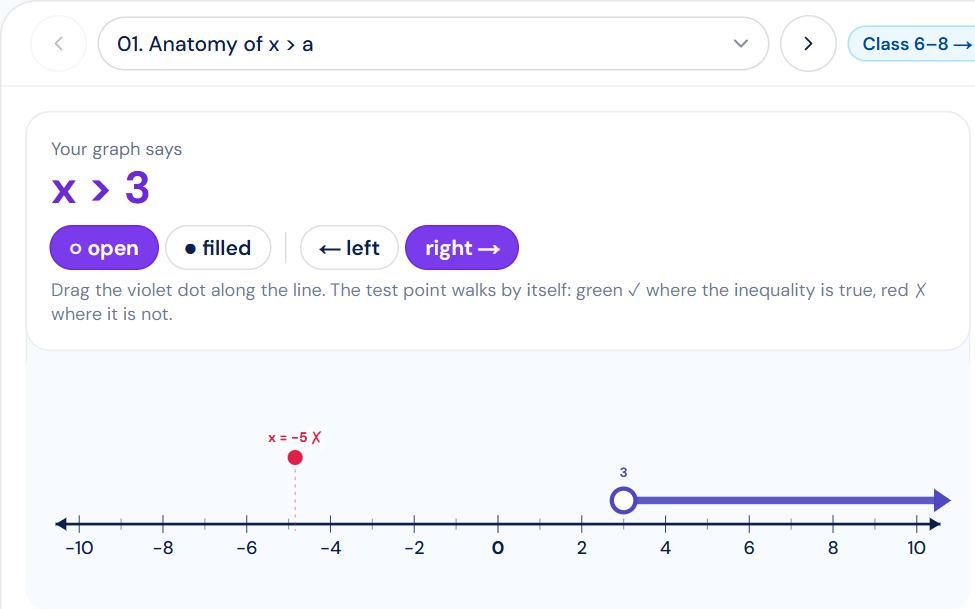
Inequalities built by hand and CHECKed, one step at a time, like the classic GeoGebra practice apps: drag the boundary dot, set it open or filled and the shading left or right, CHECK until CORRECT — 8 questions a set. Then solve-and-graph (the sign flip when dividing by a negative), “and”/“or” compound inequalities, |x − a| as a distance, the JEE wavy-curve method in three checked steps (mark, sign, shade) for products and quotients, and half-planes on a grid. A test point keeps walking along your graph, green where your drawing says it passes.

Interactive virtual lab · no download · works on phones and laptops

Chapter
Inequalities
For
Class 6–12 · JEE Main · JEE Advanced
Time
~40 min

Inequalities Step-by-Step Lab is a Pro simulation

Pro opens all 159 virtual labs — 745 simulations with guides and quizzes.

How to use it

  1. 1Pick a module from the list (8, in three groups); set your level at the top right — higher levels give harder questions.
  2. 2Drag the dot(s) on the number line or the points on the grid, use the switches, then press CHECK. A wrong CHECK lists exactly what to fix.
  3. 3Use Predict before you look, then Derive, Questions, Practise and Compare.

What to notice

  • Filled dot for (the boundary passes); hollow for . Shade the side a test number says.
  • Multiplying or dividing both sides by a negative number turns the sign round: .
  • “And” keeps the overlap (between), “or” keeps both rays (outside); is “within of ”.
  • Wavy curve: mark the critical points, start + on the far right, flip at each odd power, bounce at an even one; a denominator's zero is always hollow.
  • is the region above a dashed line; makes the line solid. Test to pick the side.

For teachers

A ready-made teaching kit comes with this lab

  • Lesson plan

    38 min, 4 steps

  • Ask the class

    4 questions with answers

  • Quick quiz

    7 questions, printable

  • Key formulas

    5 formulas

About the Inequalities Step-by-Step Lab simulation

The Inequalities Step-by-Step Lab teaches graphing and solving inequalities the way a good practice app does: you build the answer yourself and press CHECK. On a number line from −10 to 10 you drag a boundary dot, switch it between open (hollow, the boundary is not included) and filled, and shade left or right. A wrong CHECK lists exactly which of the three parts to fix; a right one says CORRECT and moves you to the next of eight questions. All the while a test point walks along the line by itself, lighting green on the numbers your drawing says pass and red elsewhere, so a graph always means something.

Later modules add one idea at a time: solving ax + b > c line by line, where dividing by a negative number turns the sign round; compound inequalities with “and” (the overlap between two boundaries) and “or” (two rays outward); modulus inequalities such as |x − 2| < 3, read as distances from a centre; the JEE wavy-curve method for products like (x − 1)(x + 2)(x − 4) > 0 and quotients like (x − 1)/(x + 3) ≤ 0, done in three checked steps — mark the critical points, sign every interval starting from + on the far right, then shade and fill the dots; and half-planes, where you drag two points onto the boundary line, make it solid or dashed and tap the side to shade. Levels change the questions: from Class 9–10 some are written backwards (5 > x), and at JEE level squared factors appear, where the sign does not change.

Also covers: inequalities, linear inequalities, linear inequalities class 11, graphing inequalities on a number line, inequality number line, open and closed dot inequality, solve and graph inequalities, dividing by a negative number flips the inequality, compound inequalities, and or inequalities, double inequality, modulus inequality, absolute value inequality, |x - a| < b, wavy curve method, method of intervals, sign scheme, rational inequalities, quadratic inequalities, linear inequalities in two variables, half plane, graphing linear inequalities, inequalities practice, inequalities jee.

Frequently asked questions

When do you use an open dot and when a filled dot on a number line?

A filled dot means the boundary number itself is part of the answer, which happens with ≥ and ≤ (the line under the symbol means “or equal”). An open (hollow) dot means the boundary is not included, which happens with strict > and <. In the lab, try it with the walking test point: on a hollow dot it turns red exactly at the boundary.

Why does the inequality sign flip when you divide by a negative number?

Multiplying by −1 reflects the number line in 0, which reverses the order of every pair of numbers: 2 < 3 but −2 > −3. Dividing by a negative number is multiplying by a negative number, so the order — and the sign — turns round. Adding or subtracting never does this.

What is the wavy-curve method?

It solves inequalities like (x − 1)(x + 2)(x − 4) > 0 without multiplying out. Mark the points where a factor is zero; on the far right every bracket is positive, so the expression has the sign of its leading coefficient; moving left, the sign changes at each critical point with an odd power and stays the same at an even power. Shade the intervals with the sign you want. For a quotient, the zeros of the denominator are critical points too but are never included.

How do you shade a linear inequality in two variables?

Draw the line y = mx + c — solid if the inequality is ≥ or ≤, dashed if it is > or < — then test a point not on the line, usually (0, 0). If the test point satisfies the inequality, shade its side; otherwise shade the other side.