About the Ellipse Reflection 3D Lab simulation
The Ellipse Reflection Lab shows how a property you meet in Class 11 conic sections is used by doctors to break kidney stones. On a 3D elliptical mirror wall, a ray from one focus hits the wall and reflects through the other focus while the point it hits sweeps round by itself; drag the point anywhere and the two angles with the normal stay equal. Then a whole pulse leaves the first focus: its dots draw the wavefront, which reflects off the wall and shrinks onto the second focus, every part arriving together because every path is 2a long.
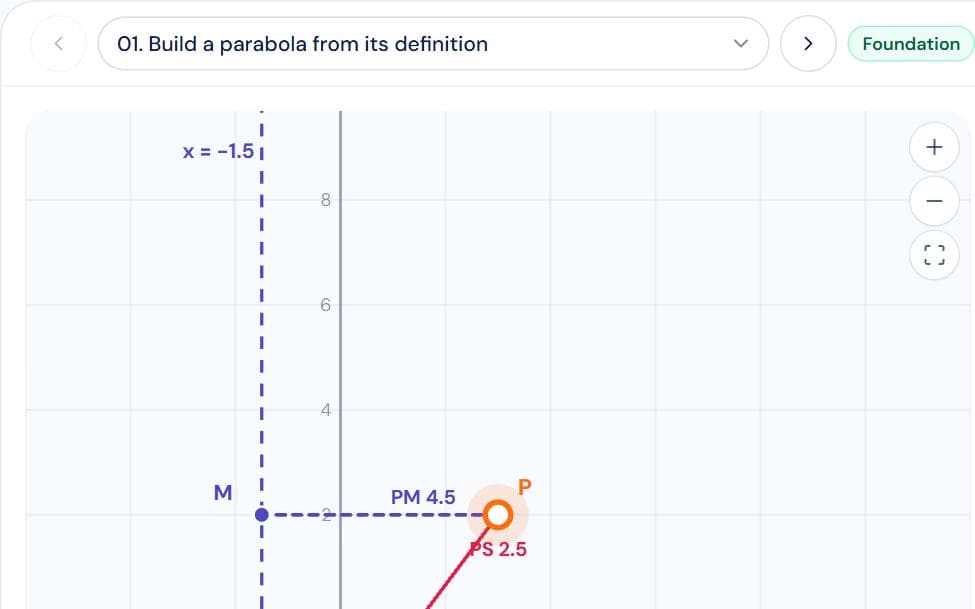
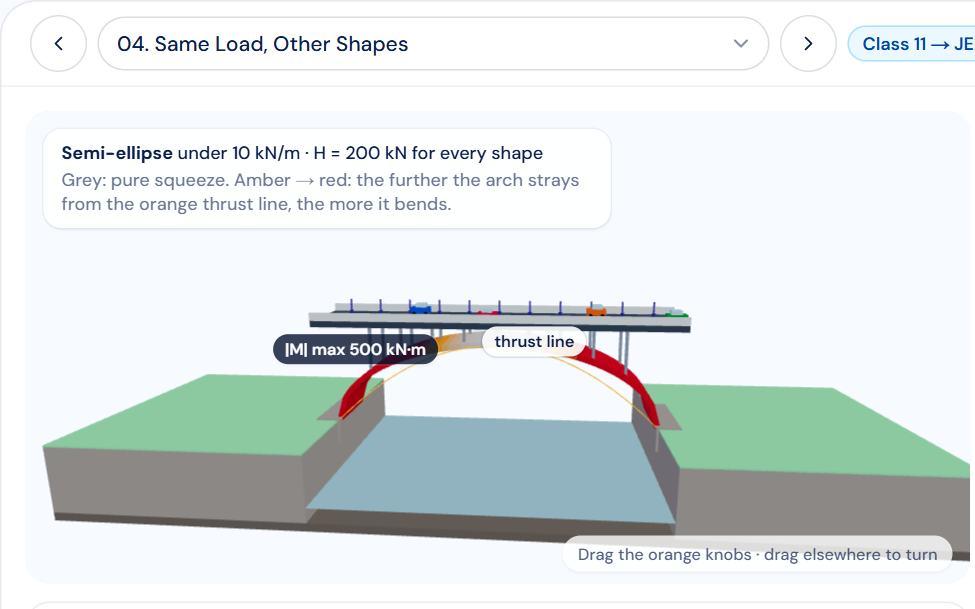
Drag the source off the focus and the meeting point smears out — the property belongs to the foci only. The lithotripter module cuts open a half-ellipsoid reflector under a water bath: a hand presses the fire button, a spark flashes at the first focus, the shock wave reflects and converges, and the kidney stone cracks and breaks into fragments only once you slide the patient so that the stone sits on the second focus. You can then design the reflector from the stone's depth (b = √(a² − c²), e = c/a, the share of the shock the bowl catches), compare elliptical, parabolic and circular mirrors (headlight, dish, concave mirror), walk a listener round a whispering gallery, and finish with the JEE results behind the property: the normal meets the major axis at G = (e²x₁, 0) with SG = e·SP, and the perpendiculars from the foci to a tangent multiply to b².
Also covers: reflection property of ellipse, ellipse reflection property, lithotripsy, lithotripsy ellipse, kidney stone ellipse, extracorporeal shock wave lithotripsy, eswl, whispering gallery, whispering gallery ellipse, elliptical mirror, ellipsoid reflector, focus of ellipse, foci of ellipse, applications of ellipse, real life application of ellipse, normal bisects focal radii, sg = e sp, product of perpendiculars from foci b^2, auxiliary circle feet of perpendiculars, parabolic mirror vs elliptical mirror, conic sections class 11 application.