About the Two Circles, One Hidden Curve 3D Lab simulation
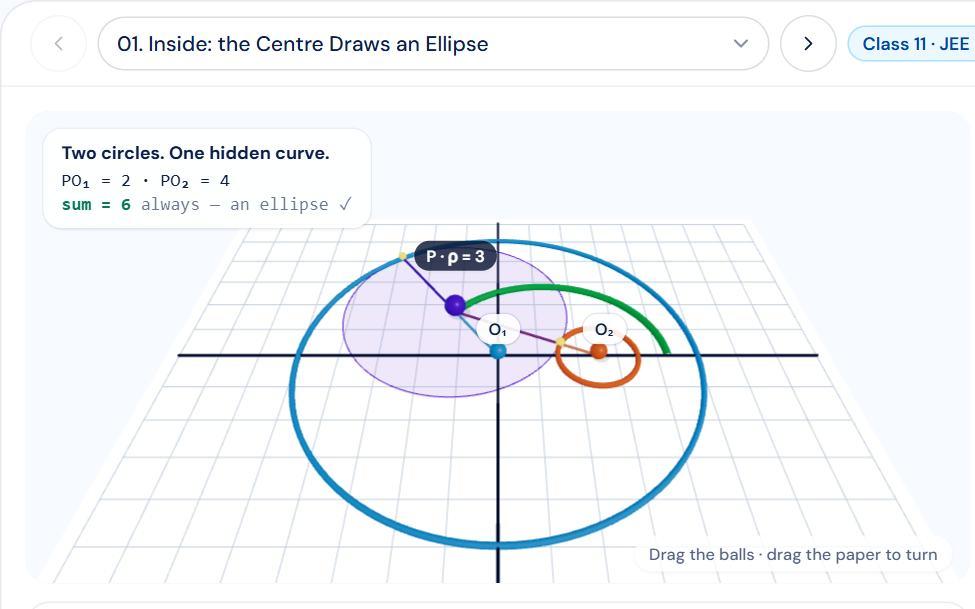
The Two Circles, One Hidden Curve 3D Lab is the simulation of our video of the same name. On graph paper in 3D, a big blue circle (radius 5) holds a small orange one (radius 1) inside it, and a purple circle keeps squeezing between them — inside the big one, outside the small one — while its centre P leaves a thick green trail. The trail stops at 85 % and asks you to predict the shape: a circle, an egg, or something else? Then the meter answers: PO₁ = R − ρ and PO₂ = r + ρ, so PO₁ + PO₂ = R + r = 6 whatever the moving circle's radius ρ, and the curve is an ellipse with the two centres as its foci (a = 3, b ≈ 2.73).
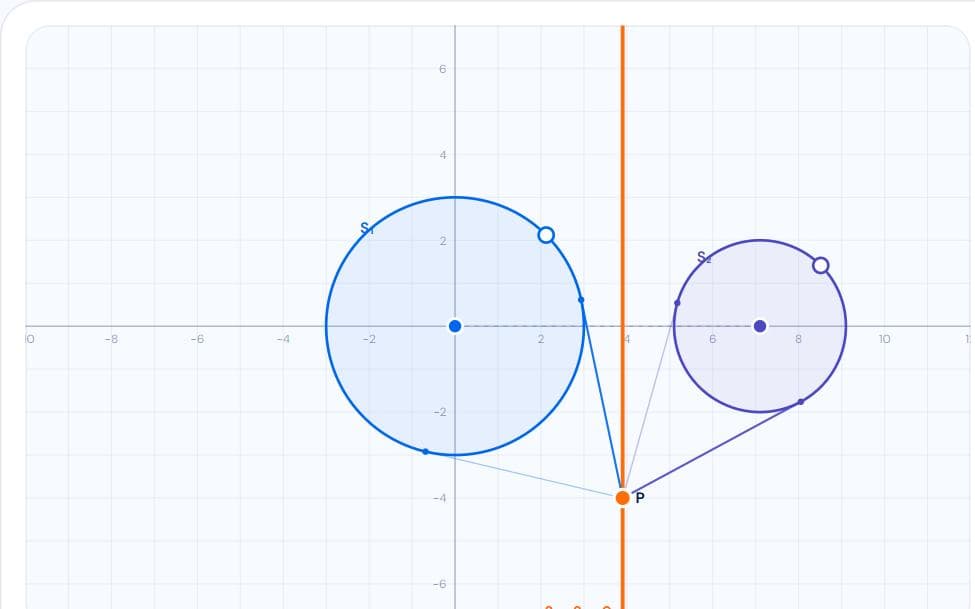
Pull the circles apart (radii 4 and 0.8, centres 6 apart) and touch both from outside: now subtracting cancels ρ, PO₁ − PO₂ = R₁ − R₂ = 3.2, and the centre draws one branch of a hyperbola — only one, because P is always nearer the small circle. The other branch appears when the moving circle swallows both. Shrink the big circle and the branch flattens into the perpendicular bisector when the radii are equal. The last module lets you choose the layout and the way each circle is touched, and explains when the result is an ellipse, a hyperbola branch, a line or impossible.
Also covers: locus of centre of circle touching two circles, circle touching two circles locus, locus of centre of a circle which touches two given circles, circles generate conic sections, ellipse as locus, hyperbola as locus, sum of focal distances, difference of focal distances, pf1 + pf2 = 2a, |pf1 - pf2| = 2a, one branch of hyperbola, perpendicular bisector locus, conic sections jee, locus jee, circles touching internally and externally.