About the Titration Lab (3D): Acid–Base & KMnO₄ simulation
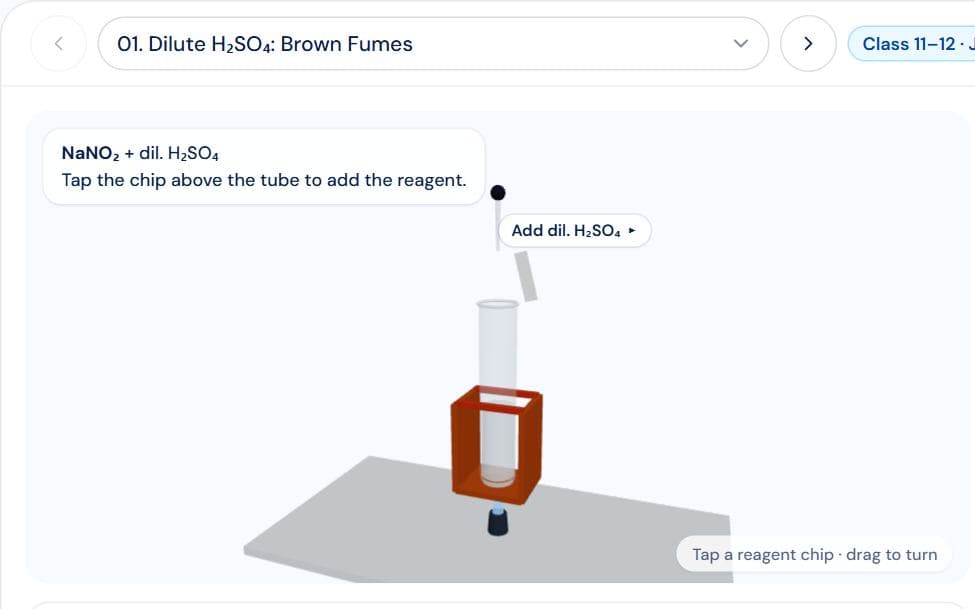
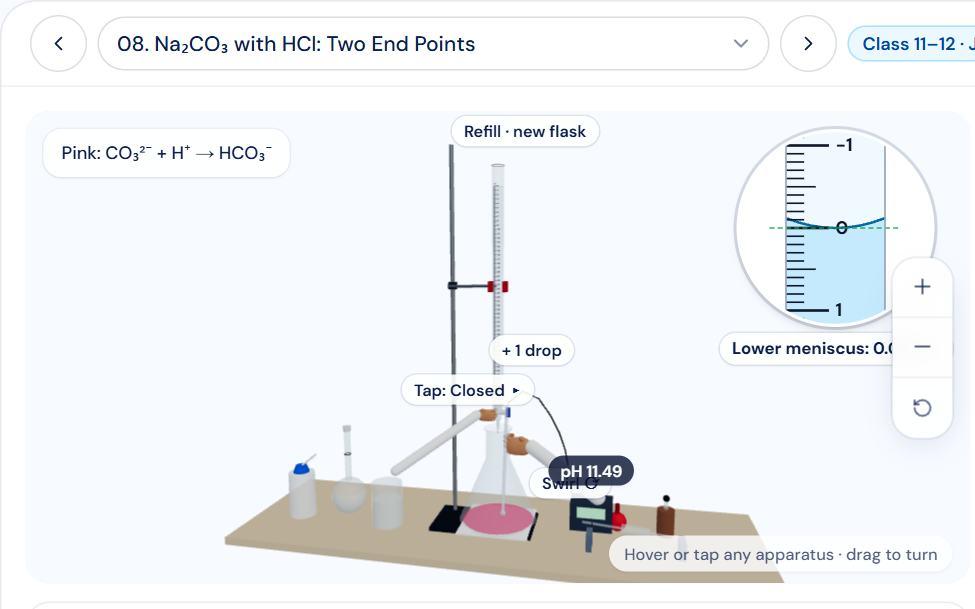
This titration virtual lab puts a full volumetric-analysis bench in 3D: a 50 mL burette held in a clamp stand, a conical flask on a white tile, a volumetric pipette with its filler, a wash bottle, an indicator bottle and a volumetric flask. Hover over any piece (or tap it on a phone) and it tells you what it is for and how it is used — which apparatus is rinsed with the solution and which with water, why the funnel comes off before reading, why the pipette's last drop is never blown out. The burette is engraved every 0.1 mL from 0 at the top to 50 at the bottom, and a lens beside it shows the meniscus on the scale exactly as you would read it.
Run a titration the way it is done in the Class 11–12 practical. A hand turns the stopcock — closed, drop by drop, or a stream — and another hand swirls the flask. Each drop makes a pocket of colour that fades as it mixes: quickly while plenty of acid is left, more and more slowly as the end point nears, and faster when you swirl. Stop at the first faint pink that lasts, save the run, refill and repeat until two titres agree within 0.1 mL. Inside the flask shows the same titration as particles: OH⁻ ions arriving with each drop, meeting H₃O⁺ to make water, Na⁺ and Cl⁻ looking on, and the indicator's HIn and In⁻ forms changing over.
Ten modules cover the syllabus: the apparatus; reading a burette (meniscus and parallax); a first HCl–NaOH titration with unknown acids; the pH curve and its jump, drawn live by a pH meter; how an indicator works (HIn ⇌ H⁺ + In⁻, a range of about pK ± 1); choosing the right indicator for strong and weak acids and bases; a weak acid's buffer region and pH = pKa at half-equivalence; sodium carbonate's two end points with phenolphthalein and methyl orange; potassium permanganate as a self-indicator against oxalic acid and Mohr's salt, with warming and autocatalysis; and the classic mistakes and which way each pushes the answer. The pH everywhere is solved from the full charge balance, not from shortcut formulas.
Also covers: titration, titration virtual lab, titration simulation, acid base titration, burette, how to read a burette, burette least count, meniscus reading, parallax error burette, pipette, conical flask, white tile titration, titration apparatus, end point, equivalence point, phenolphthalein, methyl orange, methyl red, bromothymol blue, choice of indicator, indicator range, theory of indicators, hin in- equilibrium, ph curve, titration curve, ph jump, hcl vs naoh, acetic acid vs naoh, weak acid strong base titration, half equivalence ph = pka, buffer region, ammonia vs hcl, sodium carbonate hcl two end points, double indicator titration, kmno4 titration, oxalic acid kmno4, mohr's salt titration, self indicator, autocatalysis mn2+, concordant readings, m1v1 = m2v2, normality titration, volumetric analysis, titration errors, class 11 chemistry lab experiment, class 12 chemistry lab experiment.