Skip to content
Reactions & Equilibrium · Chemistry

Nitrite Ion Tests Virtual Lab: Brown Ring & Griess

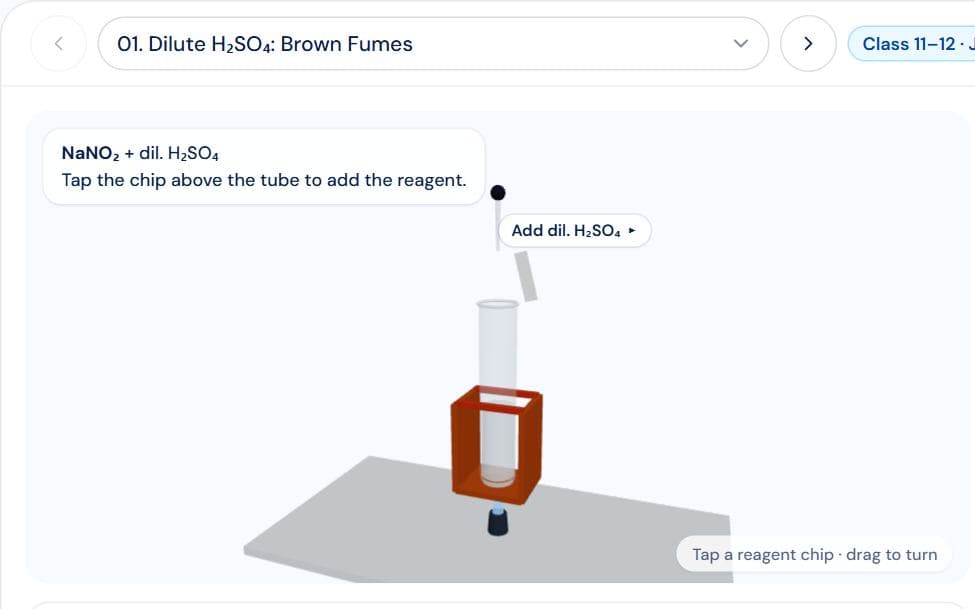
A 3D test-tube bench for the nitrite ion. Add each reagent to a tube of the salt and watch what happens: brown fumes with dilute acid, a brown solution with ferrous sulphate (where nitrate gives nothing), blue-black iodine with KI and starch, pink KMnO₄ decolourised, the red azo dye of the Griess test — then remove nitrite with urea to test for nitrate, and identify unknown salts from your own results.

Interactive virtual lab · no download · works on phones and laptops

Chapter
Salt Analysis (Qualitative Analysis)
For
Class 11–12 · JEE · NEET
Time
~30 min

Nitrite Ion Tests (Salt Analysis) is a Pro simulation

Pro opens all 152 virtual labs — 693 simulations with guides and quizzes.

How to use it

  1. 1Pick a test from the list (6); tap the reagent chip on the 3D bench to add it to the tube.
  2. 2Choose the salt in the tube, or an unknown in the last module, and read the observation and inference.
  3. 3Use Predict before you add the reagent, then Derive (equations), Questions, Practise and Compare.

What to notice

  • Dilute H₂SO₄ gives brown NO₂ fumes with nitrite; nitrate needs concentrated acid.
  • FeSO₄ in dilute acetic acid turns brown with nitrite only — this tells nitrite from nitrate.
  • Nitrite is both an oxidant (I⁻ → I₂, blue with starch) and a reductant (MnO₄⁻ → Mn²⁺).
  • Sulphite and sulphide also decolourise KMnO₄: one test alone is not proof.
  • Nitrite also gives the brown ring, so destroy it with urea or sulphamic acid before testing for nitrate.

For teachers

A ready-made teaching kit comes with this lab

  • Lesson plan

    31 min, 4 steps

  • Ask the class

    5 questions with answers

  • Quick quiz

    6 questions, printable

  • Key formulas

    6 formulas

About the Nitrite Ion Tests (Salt Analysis) simulation

The nitrite ion (NO₂⁻) is one of the anions in Class 11–12 salt analysis, and telling it from nitrate (NO₃⁻) is a favourite question in practicals, boards, JEE and NEET. This nitrite test virtual lab puts a test tube on a 3D bench: tap the reagent chip and the reagent drops in, the liquid changes colour, gas bubbles up, fumes curl out of the mouth and the test paper at the mouth changes — the same observations you would write in a lab record, with the inference and the balanced equations alongside.

Work through the standard scheme: warm the salt with dilute sulphuric acid for brown NO₂ fumes; add ferrous sulphate in dilute acetic acid, which browns with nitrite but not nitrate; run the brown ring test and see why nitrite interferes with it; free iodine from potassium iodide (nitrite as an oxidising agent, blue-black with starch); decolourise acidified potassium permanganate (nitrite as a reducing agent); and make the red azo dye of the Griess test, sensitive to well under a milligram of nitrite per litre. Each test can be run on carbonate, sulphite, sulphide, acetate and chloride as well, so you can see which tests are specific and which are not.

The last module hands you unknown salts. Six tubes of the same unknown sit in a rack, one per test; run as many as you need, read your record, and decide whether the salt holds nitrite, nitrate, both or neither — remembering that urea or sulphamic acid must destroy nitrite before the ring test can prove nitrate.

Also covers: nitrite ion test, test for nitrite, no2- test, salt analysis, qualitative analysis, anion analysis, dilute sulphuric acid group, brown fumes, nitrous acid, brown ring test, nitrate vs nitrite, distinguish nitrite and nitrate, ferrous sulphate test, [fe(h2o)5no]2+, nitrosyl complex, potassium iodide starch test, iodine starch blue, kmno4 decolourised, nitrite reducing agent, nitrite oxidising agent, griess test, griess ilosvay, sulphanilic acid, 1-naphthylamine, azo dye, diazotisation, urea removes nitrite, sulphamic acid, carbonate test, sulphite test, sulphide test, acetate test, chemistry lab anion tests.

Frequently asked questions

How do you distinguish nitrite from nitrate?

Add dilute acid: nitrite gives brown NO₂ fumes, nitrate gives nothing. Or add ferrous sulphate in dilute acetic acid: nitrite turns the solution brown at once, nitrate does not react until concentrated sulphuric acid is used. KI with starch (blue-black) and the Griess test (red) also respond to nitrite only.

Why does nitrite interfere with the brown ring test?

Nitrite also reduces Fe²⁺-containing solutions to give NO, which forms the same brown [Fe(H₂O)₅(NO)]²⁺ complex. So a brown ring proves nitrate only if nitrite is absent or has been destroyed first — by warming with urea or sulphamic acid, which turn nitrous acid into nitrogen gas.

Is nitrite an oxidising agent or a reducing agent?

Both. Nitrogen in nitrite is +3, between its lowest (−3) and highest (+5) states. With iodide it is the oxidising agent (I⁻ → I₂, N goes to +2 in NO); with permanganate it is the reducing agent (MnO₄⁻ → Mn²⁺, N goes to +5 in nitrate).

What is the Griess test?

A test for traces of nitrite. In acetic acid, nitrous acid diazotises sulphanilic acid; the diazonium ion then couples with 1-naphthylamine to give a red azo dye. Because the dye absorbs light so strongly, nitrite well below 1 mg per litre gives a visible colour — it is used to test drinking water.

What is the oxidation state of iron in the brown ring complex?

In the NCERT/JEE description of [Fe(H₂O)₅(NO)]²⁺, NO is taken as the nitrosonium ion NO⁺, which makes iron +1. (Spectroscopy suggests a different electron count, but +1 is the answer expected in Indian exams.)