Skip to content
Human Physiology · Biology

Breathing & Exchange of Gases Simulation: 13 3D Labs

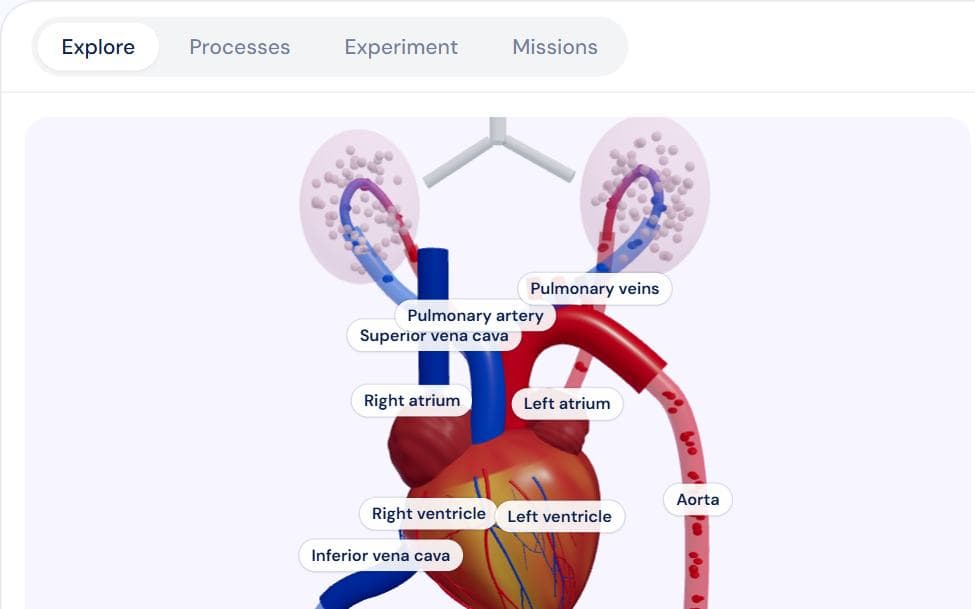
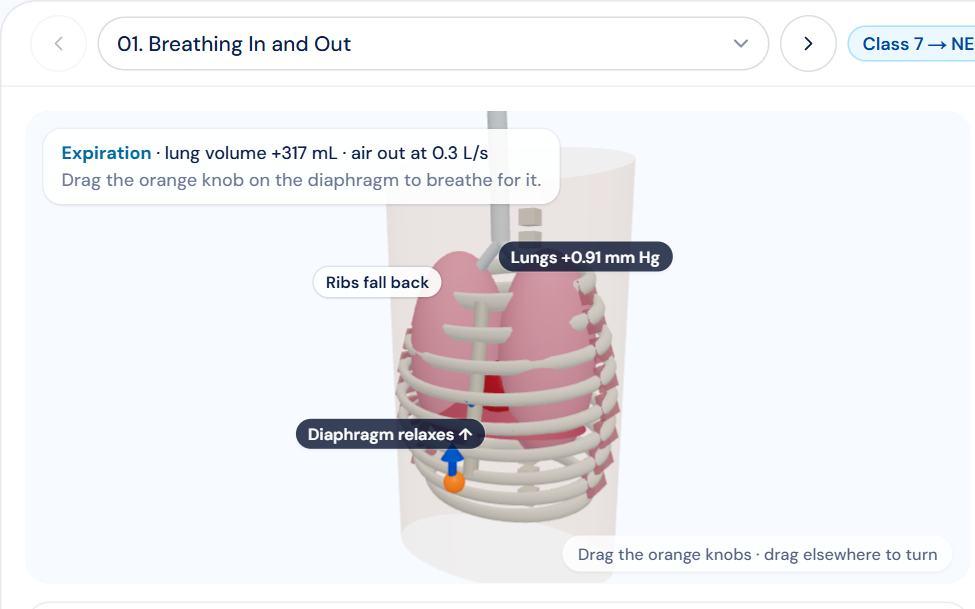
The whole path of a breath, in 3D: a see-through chest that breathes on its own while you drag its diaphragm, a demonstrator pulling the rubber sheet of a bell-jar model and blowing into lime water, a spirogram whose volumes you drag, a cut-open alveolus where blood turns from purple to red, haemoglobin filling its four haems, the dissociation curve sliding with the Bohr effect, CO₂ riding as bicarbonate, a working biceps taking more oxygen, a mitochondrion counting its 38 ATP, fermentation and the respiratory quotient — and NCERT's five steps with a sorting game.

Interactive virtual lab · no download · works on phones and laptops

Chapter
Breathing & Exchange of Gases
For
Class 7–11 · NEET
Time
~40 min

Breathing & Respiration 3D Lab is a Pro simulation

Pro opens all 159 virtual labs — 745 simulations with guides and quizzes.

How to use it

  1. 1Pick a module from the list (13, in six groups, in the order a breath travels); set your level at the top right.
  2. 2Every scene runs by itself — drag the orange knobs (the diaphragm, the rubber sheet, the probe, the dumbbell) or tap the chips to drive it.
  3. 3Use Predict before you look, then Derive, Questions, Practise and Compare; tap a live value marked ƒ to see its formula.

What to notice

  • Air flows in only while the lungs are below atmospheric pressure — about 1 mm Hg at rest; the diaphragm and external intercostals make that happen.
  • Each gas diffuses down its own partial-pressure gradient: mm Hg into the blood, out of it.
  • About 97 % of O₂ rides on haemoglobin, ; its sigmoid curve shifts right with more CO₂, H⁺ and heat.
  • CO₂ travels about 70 % as bicarbonate, 20–25 % as carbamino-haemoglobin and 7 % dissolved.
  • External, internal and cellular respiration are different stages; O₂ is used up only in the mitochondria, where one glucose gives 38 ATP (NCERT).

For teachers

A ready-made teaching kit comes with this lab

  • Lesson plan

    38 min, 4 steps

  • Ask the class

    5 questions with answers

  • Quick quiz

    7 questions, printable

  • Key formulas

    7 formulas

About the Breathing & Respiration 3D Lab simulation

The Breathing & Respiration Lab follows one breath all the way from the air to a mitochondrion, in thirteen 3D experiments in the order the oxygen travels. A see-through chest breathes on its own — the diaphragm flattens, the ribs lift, the lung pressure dips about 1 mm Hg below the atmosphere — and you can drag the diaphragm to breathe for it. A demonstrator pulls the rubber sheet of a bell-jar model, and blows through lime water beside a tube of room air to show where the CO₂ goes.

Then the exchange: a cut-open alveolus with blood cells entering purple and leaving red, a probe that reads the blood's pO₂ along the capillary, and Fick's law on a membrane whose area and thickness you drag (emphysema, oedema). Transport: one haemoglobin molecule filling its four haems as the pO₂ rises, the sigmoid dissociation curve sliding right with CO₂, H⁺ and temperature (the Bohr effect, foetal haemoglobin, myoglobin), and CO₂ travelling as bicarbonate, carbamino-haemoglobin and dissolved gas, with carbonic anhydrase and the chloride shift.

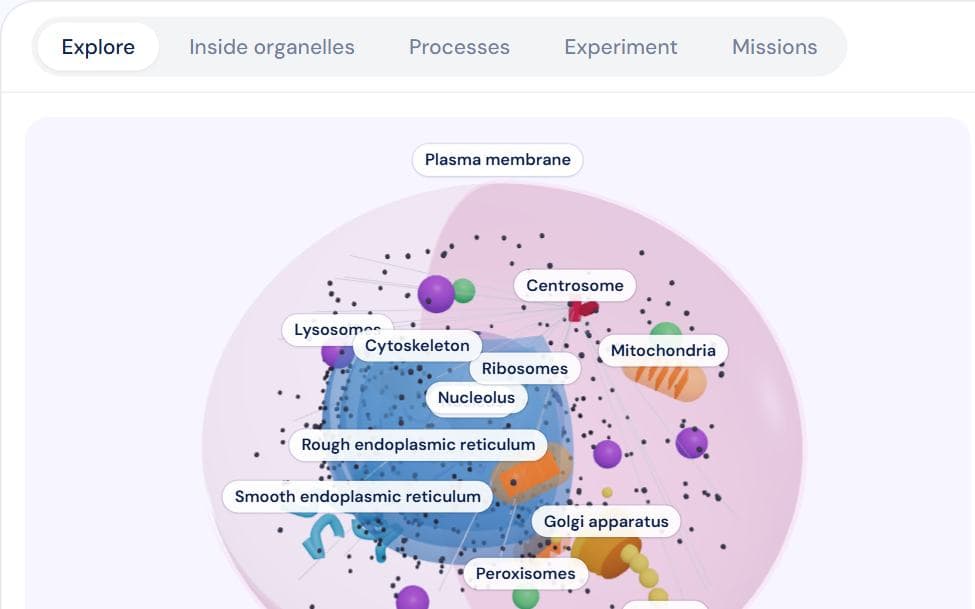
At the tissues, a demonstrator curls a dumbbell beside a magnified piece of the biceps: work harder and the blood hands over three times as much O₂. Inside the cell, a mitochondrion runs glycolysis, the link reaction, the Krebs cycle and the electron transport system and counts NCERT's 38 ATP; fermentation in yeast and muscle and the respiratory quotient follow. The last module lays out NCERT's five steps and asks you to sort statements into external, internal and cellular respiration — a favourite NEET question.

Also covers: breathing and exchange of gases, breathing and exchange of gases simulation, respiration class 11, neet breathing and exchange of gases, mechanism of breathing, inspiration and expiration, diaphragm and intercostal muscles, bell jar model of lungs, lung volumes and capacities, tidal volume, vital capacity, residual volume, spirometer, spirogram, inhaled and exhaled air, lime water test exhaled air, partial pressure of oxygen, alveoli gas exchange, external respiration, internal respiration, cellular respiration, transport of oxygen, oxyhaemoglobin, oxygen dissociation curve, bohr effect, foetal haemoglobin, transport of carbon dioxide, carbonic anhydrase, bicarbonate, carbamino haemoglobin, chloride shift, glycolysis, krebs cycle, electron transport system, 38 atp, fermentation, lactic acid, respiratory quotient, class 10 life processes respiration, respiration in plants.

Frequently asked questions

What is the difference between breathing and respiration?

Breathing is the physical movement of air into and out of the lungs. Respiration includes the exchange of gases at the alveoli (external respiration), their transport in blood, the exchange at the tissues (internal respiration) and, inside cells, the oxidation of food to release energy (cellular respiration). Breathing is a physical process; cellular respiration is a chemical one.

Why does air flow into the lungs during inspiration?

The diaphragm contracts and flattens and the external intercostal muscles lift the ribs and sternum. The chest gets bigger, the lungs follow it, and by Boyle's law the pressure inside them falls slightly below atmospheric. Air moves from the higher pressure outside to the lower pressure inside until they are equal.

Why is the oxygen dissociation curve sigmoid, and what is the Bohr effect?

Haemoglobin has four haem groups. When one binds oxygen the shape of the molecule changes so the next binds more easily (cooperative binding). Saturation therefore rises slowly at low pO₂, very steeply between about 10 and 50 mm Hg, and levels off near 100 %. The flat top keeps blood almost fully loaded in the lungs; the steep middle lets the tissues take a lot of oxygen for a small fall in pO₂. More CO₂, H⁺ or heat — the conditions in active tissue — shift the curve right (the Bohr effect), so even more oxygen is unloaded where it is needed.

How is carbon dioxide transported in the blood?

About 70 % as bicarbonate ions, formed in red blood cells by carbonic anhydrase (CO₂ + H₂O → H₂CO₃ → H⁺ + HCO₃⁻); about 20–25 % bound to haemoglobin as carbamino-haemoglobin; and about 7 % dissolved in plasma. Every 100 mL of deoxygenated blood delivers about 4 mL of CO₂ to the alveoli.

How many ATP does one glucose give?

Using NCERT's count, aerobic respiration gives a net 38 ATP: 4 made directly (2 in glycolysis, 2 in the Krebs cycle) and 34 through the electron transport system from 10 NADH (×3) and 2 FADH₂ (×2). Modern measurements give about 30–32. Fermentation gives only 2.