About the Optical Instruments Lab (3D): Microscope & Telescope simulation
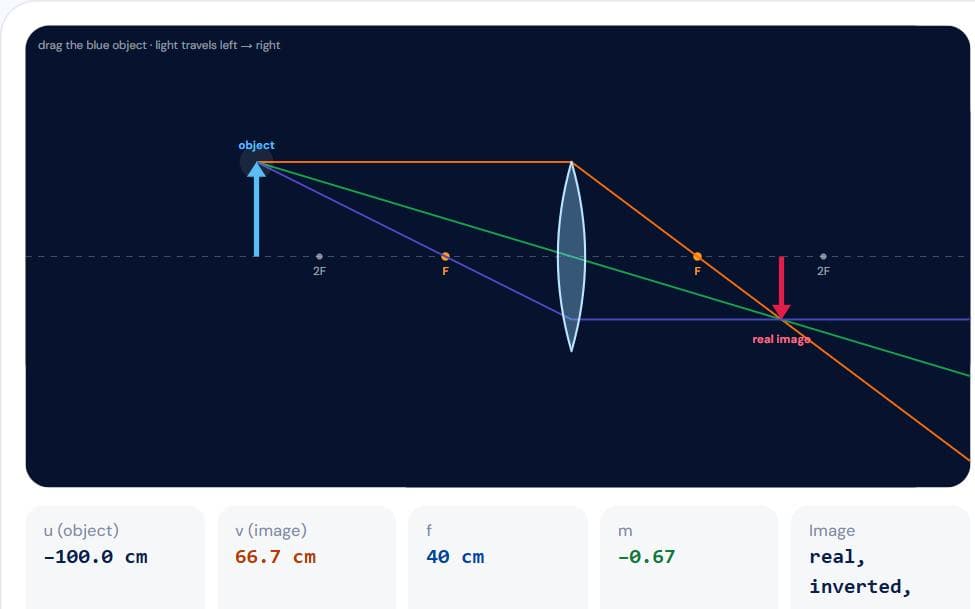
This optical instruments simulation lets you build a compound microscope and a telescope from lenses on a 3D optical bench and see exactly how they work. Slide the objective and eyepiece along the rail: the bench traces the light through both lenses with the thin-lens law and shows every image — real ones solid, virtual ones faint — and it rejects wrong arrangements with the reason: a concave objective makes no real image, a specimen beyond 2F gives a smaller image, an eyepiece too far away makes a real image instead of a magnified virtual one.
Then use a real microscope. Put onion peel, cheek cells, pollen, a swimming paramecium, textile fibres or a printed letter on the stage and click the 4×, 10× and 40× objectives into place. Each specimen is drawn at its true size in micrometres, so the field of view really shrinks to a quarter at 40×, the image dims, and focusing with the fine knob becomes delicate as the depth of field shrinks to about a micrometre. A resolution experiment shows two points blurring into one at the Rayleigh limit d = 0.61λ/NA, and why more magnification cannot reveal more detail.
The telescope half builds an astronomical telescope (M = −fo/fe, length fo + fe), points a 3D refractor at the Moon, Jupiter, Saturn or a far-off mountain at true angular sizes, and compares the Galilean telescope (erect image, short tube) and Newton's reflector. Eleven modules finish with the telescope-or-microscope challenge and a side-by-side table.
Also covers: compound microscope, compound microscope simulation, microscope virtual lab, magnifying power of microscope, objective lens, eyepiece, tube length, normal adjustment, image at infinity, least distance of distinct vision, m = l/fo × d/fe, simple microscope, magnifying glass, parts of a microscope, onion peel under microscope, cheek cells under microscope, pollen grains, paramecium, field of view, 4x 10x 40x objective, depth of field, resolving power, resolution of microscope, rayleigh criterion, numerical aperture, oil immersion, empty magnification, astronomical telescope, refracting telescope, magnifying power of telescope, fo/fe, length of telescope fo + fe, galilean telescope, reflecting telescope, newtonian telescope, telescope vs microscope, class 12 ray optics optical instruments, jee optical instruments numericals, neet microscope.