Skip to content
Light & Optics · Physics

Young's Double Slit Experiment: 3D Simulation

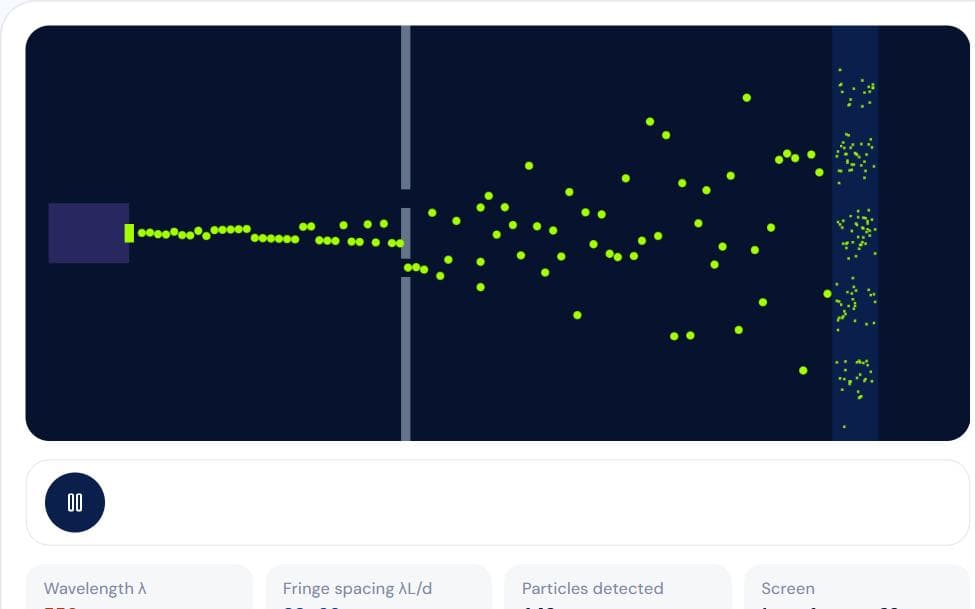
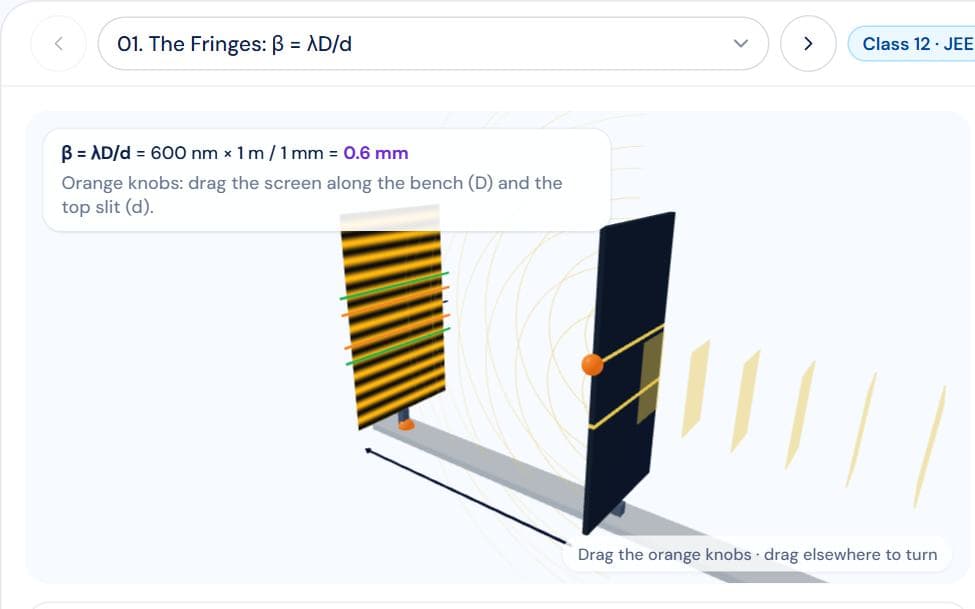
Young's experiment on a 3D optical bench: a laser, two slits and a screen, with wavefronts spreading from both slits and the fringe pattern computed on the screen. Drag the screen to change D and a slit to change d; move a probe along the screen to see path difference, phase and intensity; cover one slit with a glass sheet, raise the source slit, switch to white light, fill the bench with water, and give the slits a real width so the envelope wipes out whole orders — then send the light one photon at a time.

Interactive virtual lab · no download · works on phones and laptops

Chapter
Wave Optics
For
Class 12 · JEE · NEET
Time
~30 min

Young's Double-Slit Lab (3D) is a Pro simulation

Pro opens all 152 virtual labs — 693 simulations with guides and quizzes.

How to use it

  1. 1Pick a module from the list (6); set your level at the top right for more controls.
  2. 2Drag the orange knobs on the 3D bench — the screen's foot, the upper slit, the probe on the screen, the source slit — or type exact values.
  3. 3Use Predict before you look, then Derive, Questions, Practise (fresh numericals each time) and Compare.

What to notice

  • Fringe width β = λD/d: wider with longer wavelength and a farther screen, narrower as the slits move apart.
  • I = I₁ + I₂ + 2√(I₁I₂) cos φ: equal slits give perfectly dark fringes, unequal ones grey.
  • A sheet over one slit shifts the pattern by (μ − 1)tD/d towards that slit; the fringe width does not change.
  • Moving the source by s moves the pattern by sD/a the other way; with white light only the centre is white.
  • In a liquid β falls to β/μ; real slits put the fringes inside a diffraction envelope, and photons build the same pattern one by one.

For teachers

A ready-made teaching kit comes with this lab

  • Lesson plan

    31 min, 4 steps

  • Ask the class

    5 questions with answers

  • Quick quiz

    6 questions, printable

  • Key formulas

    7 formulas

About the Young's Double-Slit Lab (3D) simulation

Young's double-slit experiment is the experiment that proved light is a wave, and it is the single most tested topic in Class 12 Wave Optics for JEE and NEET. This 3D Young's double slit simulation puts a laser, two slits and a screen on an optical bench you can turn round and grab: wavefronts spread from both slits all the time, and the screen shows the bright and dark fringes their overlap makes. Drag the screen along the bench or the upper slit up and down and watch the fringe width β = λD/d change in front of you.

Then the variations exam questions are built on. Move a probe along the screen to see the path difference, the phase and the intensity I = I₁ + I₂ + 2√(I₁I₂) cos φ at that point, and dim one slit to see why the dark fringes turn grey. Cover one slit with a thin glass sheet and the whole pattern slides towards it by (μ − 1)tD/d; move the source slit and it slides the other way by sD/a; switch to white light for coloured fringes round a white centre; fill the bench with water and every fringe shrinks by μ.

For JEE Advanced, give the slits a real width: the fringes sit inside a single-slit diffraction envelope that wipes out whole orders when d/w is a whole number. Finally, send the light one photon at a time and watch the same fringes build up dot by dot. Each of the six modules has a prediction, a derivation, concept questions with hints and fresh numericals.

Also covers: young's double slit experiment, ydse, double slit, interference of light, fringe width, β = λd/d, lambda d by d, path difference, phase difference, intensity in ydse, i = 4i0 cos², imax imin, unequal slit widths, visibility of fringes, glass slab in front of slit, thin sheet shift, fringe shift (μ-1)t, source slit shifted, white light fringes, coloured fringes, ydse in water, fringe width in liquid, missing orders, single slit envelope, diffraction and interference, photons one at a time, wave optics.

Frequently asked questions

What is the fringe width in Young's double-slit experiment?

β = λD/d, where λ is the wavelength, D the distance from the slits to the screen and d the slit separation. Bright fringes are at nλD/d and dark ones halfway between, so for small angles the fringes are equally spaced. For λ = 600 nm, D = 1 m and d = 1 mm, β = 0.6 mm.

Which way does the pattern shift when a glass sheet covers one slit?

Towards the covered slit. Light is slower in glass, so the sheet adds an optical path (μ − 1)t to that ray. The point where the two optical paths are equal — the central bright fringe — must then be geometrically closer to the covered slit. It moves by (μ − 1)tD/d, and the fringe width does not change.

What happens to YDSE fringes in water?

The wavelength in water is λ/μ while the frequency stays the same, so the fringe width falls to β/μ — to three-quarters for water (μ = 4/3). Because both paths are in the same liquid, the central fringe stays at the centre.

Why are only a few fringes seen with white light?

Each colour makes its own pattern with its own fringe width. All of them have a bright fringe at the centre, which is white; next to it violet's first fringe comes before red's, giving coloured fringes. A few fringes out the colours fall out of step and blend back to white.

What is a missing order in the double-slit experiment?

Real slits have a width w, so each one diffracts and the fringes are multiplied by a single-slit envelope with zeros at y = mλD/w. If a bright fringe nλD/d falls exactly on such a zero — when n = m·d/w — it vanishes. With d = 4w the 4th, 8th, 12th… orders are missing.