About the Mirror Trick: Moving Point 3D Lab simulation
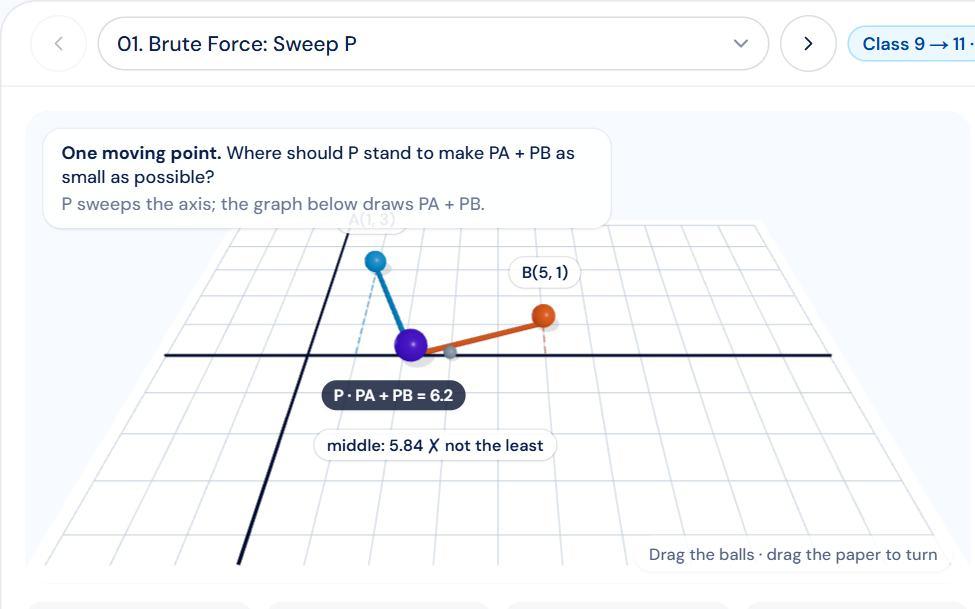
The Mirror Trick 3D Lab is the simulation of our “One moving point” video. On a sheet of graph paper in 3D, A(1, 3) is a blue ball and B(5, 1) an orange one, and a purple ball P slides along the x-axis by itself, joined to both. The first module is brute force: as P sweeps, the graph of PA + PB draws underneath, and its single dip is at x = 4 — not halfway between A and B, where most people guess.
The second module finds that dip with no calculus, in three steps you press yourself: reflect A in the axis to A′(1, −3), so PA = PA′ for every P; join A′ to B with a straight line, the shortest path; and put P where it crosses the axis. The least PA + PB is A′B = √32 = 4√2 ≈ 5.66, and a ray of light running A → P → B shows the two 45° angles are equal. The third module uses the triangle inequality: PA − PB ≤ AB, reached where line AB meets the axis, at x = 7, giving √20. The last is the video's homework: PA − PB never has a least value here, because equality would need A between P and B; it only falls towards x_A − x_B = −4 far to the left, which you can watch by stretching the graph to x = −1000. Drag A, B and P anywhere.
Also covers: minimum of pa + pb, pa + pb minimum, minimise pa + pb, point on x axis minimum distance, reflection method minimum distance, shortest path reflection, image of a point in x axis, maximum of pa - pb, |pa - pb| maximum, triangle inequality, heron's shortest path, law of reflection geometry, locus coordinate geometry jee, straight lines jee, minimum and maximum distance moving point.