Skip to content
Coordinate Geometry · Mathematics

Tangents to a Hyperbola: Interactive JEE Simulation

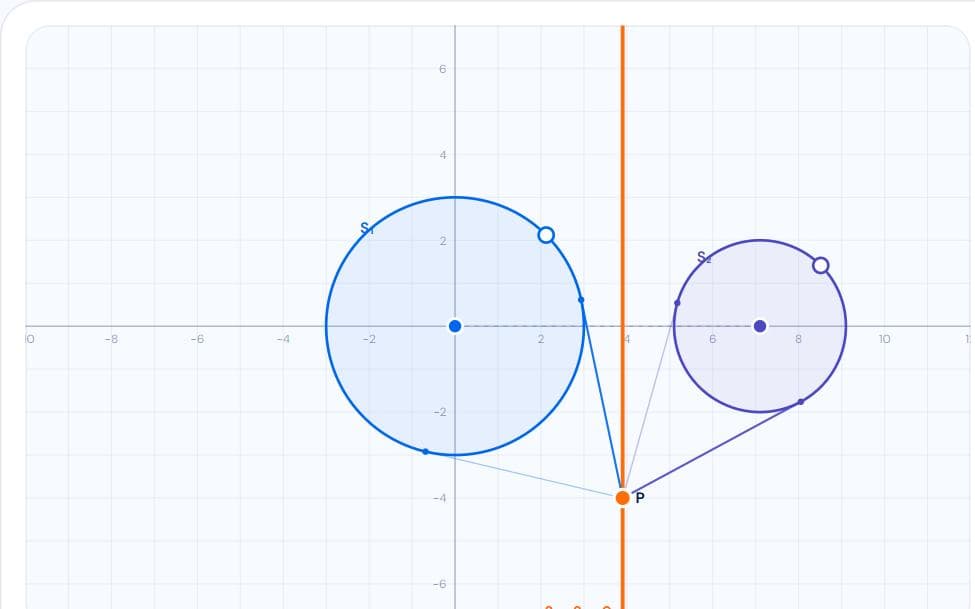
Ten interactive boards on x²/a² − y²/b² = 1 and its tangents: the interior and exterior (S₁ > 0 or < 0, and which points have tangents), the asymptotes as the diagonals of the a × b box, why a line meets a hyperbola at most twice, why a tangent never reaches the other branch and there is no common tangent to both branches, why tangents need |m| > b/a (tilt an asymptote towards the curve and it cuts, not touches), how many tangents come from a point (0, 1 or 2 — never 3 or 4), and the zones from which both tangents touch the same branch or one branch each. Drag the orange points; a grey ghost on every board moves by itself.

Interactive virtual lab · no download · works on phones and laptops

Chapter
Conic Sections
For
Class 11 · JEE Main · JEE Advanced
Time
~35 min

How to use it

  1. 1Pick a module from the list (10, in four groups); set your level at the top right.
  2. 2Drag the orange points and the line handles; change a and b with the sliders; pan and zoom the board. The grey ghost moves by itself.
  3. 3Use Predict before you look, then Derive, Questions, Practise and Compare.

What to notice

  • : positive inside a branch (interior), negative between the branches (exterior, where tangents come from).
  • A line meets a hyperbola in at most two points; a tangent uses both roots at its point of contact.
  • Tangents of slope : — real only for , one per branch, never the same line.
  • A line parallel to an asymptote crosses the hyperbola once — it is not a tangent.
  • From : two tangents if , none if or is the centre, one on the curve or an asymptote; sends both to the same branch.

For teachers

Teach it in 35 minutes

A lesson plan, questions to put to the class, a quick quiz you can project or print, and the formulas behind Hyperbola & Tangents Lab.

  1. 1Hook

    ~2 min
    • Open the simulation full screen on the projector. Before touching anything, ask the class what they expect to see, and write two or three predictions on the board.
  2. 2Demonstrate

    ~21 min
    • Pick a module from the list (10, in four groups); set your level at the top right.
    • Drag the orange points and the line handles; change a and b with the sliders; pan and zoom the board. The grey ghost moves by itself.
    • Use Predict before you look, then Derive, Questions, Practise and Compare.
  3. 3Pause and ask

    ~5 min
    • Have a student say this in their own words: S₁ = h²/a² - k²/b² - 1: positive inside a branch (interior), negative between the branches (exterior, where tangents come from).
    • Have a student say this in their own words: A line meets a hyperbola in at most two points; a tangent uses both roots at its point of contact.
    • Have a student say this in their own words: Tangents of slope m: y = mx ± √(a²m² - b²) — real only for |m| > b/a, one per branch, never the same line.
    • Have a student say this in their own words: A line parallel to an asymptote crosses the hyperbola once — it is not a tangent.
    • Have a student say this in their own words: From P(h, k): two tangents if S₁ < 0, none if S₁ > 0 or P is the centre, one on the curve or an asymptote; |k| < b/a|h| sends both to the same branch.
  4. 4Check

    ~7 min
    • Run the 7-question quiz below: project it and take answers by show of fingers (1–4), or print it as a worksheet.

About the Hyperbola & Tangents Lab simulation

The Hyperbola & Tangents Lab explains, on a live coordinate board, everything JEE asks about tangents to the hyperbola x²/a² − y²/b² = 1. It starts with the regions: substitute a point into S₁ = h²/a² − k²/b² − 1 and a positive value puts it in the interior, inside a branch around a focus, while a negative value puts it in the exterior, the region between the branches that contains the centre. Only exterior points have tangents. The asymptotes y = ±(b/a)x are the diagonals of the a × b box, and a point running along the branch shows the gap to them shrinking towards zero without ever closing.

Next come lines. Substituting y = mx + c gives the quadratic (b² − a²m²)x² − 2a²mc·x − a²(c² + b²) = 0, so a line meets a hyperbola in at most two points. A tangent is the case of equal roots, which is why the tangent at a point of one branch can never reach the other branch, and why there is no common tangent to both branches: for each slope the two tangents y = mx ± √(a²m² − b²) are parallel, a fixed gap apart, and touch one branch each. Tangents need |m| > b/a. Tilt an asymptote towards the curve and it cuts both branches rather than becoming a tangent; tilt it away and it misses. A line parallel to an asymptote crosses the curve exactly once without being a tangent.

Finally, tangents from a point P(h, k). Their slopes satisfy (h² − a²)m² − 2hk·m + (k² + b²) = 0, a quadratic, so there are never more than two. Its discriminant is −4a²b²S₁, which gives two tangents from the exterior, none from the interior or the centre, and one from a point on the curve or on an asymptote. The asymptotes also split the exterior: from beside a branch (|k| < (b/a)|h|) both tangents touch the nearer branch, and from above or below (|k| > (b/a)|h|) one tangent touches each branch. Every board also has a grey ghost that moves by itself — a sweeping line, a running point or a probe touring the zones.

Also covers: hyperbola, tangent to hyperbola, tangents to hyperbola jee, condition of tangency hyperbola, c^2 = a^2m^2 - b^2, y = mx ± √(a²m² − b²), asymptotes of hyperbola, interior and exterior of hyperbola, position of a point with respect to hyperbola, number of tangents from a point to hyperbola, pair of tangents hyperbola, common tangent to both branches, line and hyperbola intersection, director circle hyperbola, tangent at a point of hyperbola, hyperbola class 11, conic sections jee, hyperbola simulation.

Frequently asked questions

How many tangents can be drawn to a hyperbola from a point?

At most two. The slopes of the tangents from P(h, k) satisfy the quadratic (h² − a²)m² − 2hk·m + (k² + b²) = 0, whose discriminant is −4a²b²(h²/a² − k²/b² − 1). From a point in the exterior (between the branches) there are two tangents, from the interior (inside a branch) none, from a point on the hyperbola one, and from a point on an asymptote one. From the centre there are none: both roots give the asymptotes, which are not tangents.

Why is there no common tangent to the two branches of a hyperbola?

For a slope m the only tangents are y = mx + √(a²m² − b²) and y = mx − √(a²m² − b²). They touch at (−a²m/c, −b²/c), so the sign of c decides the branch: one line touches the right branch, the other the left. A common tangent would need both intercepts at once, which forces c = 0 and m = ±b/a — the asymptote, which never meets the curve.

What is the condition for y = mx + c to be a tangent to a hyperbola?

c² = a²m² − b². It comes from making the discriminant of (b² − a²m²)x² − 2a²mc·x − a²(c² + b²) = 0 zero. Because c² cannot be negative, a tangent of slope m exists only when |m| > b/a; slopes between −b/a and b/a have no tangent, and a line parallel to an asymptote crosses the curve once without touching it.

From which points do both tangents touch the same branch of a hyperbola?

From exterior points beside a branch, between the branch and the asymptotes, where |k| < (b/a)|h|: both tangents touch the nearer branch. From exterior points above or below the centre, where |k| > (b/a)|h|, one tangent touches each branch. The asymptotes are the border, and from a point on an asymptote only one tangent can be drawn.