About the Biology 3D Lab: 20 Life Processes simulation
The Biology 3D Lab is a set of twenty simulations of the processes students find hardest to picture from a blackboard — things that are invisible, happen in a sequence, or move in several places at once. Each one is a 3D scene that plays by itself. Step through it with Back and Next, or switch on “What happens next?”: the scene stops after each event and asks you to choose the next one before it goes on, so you recall the sequence instead of watching it.
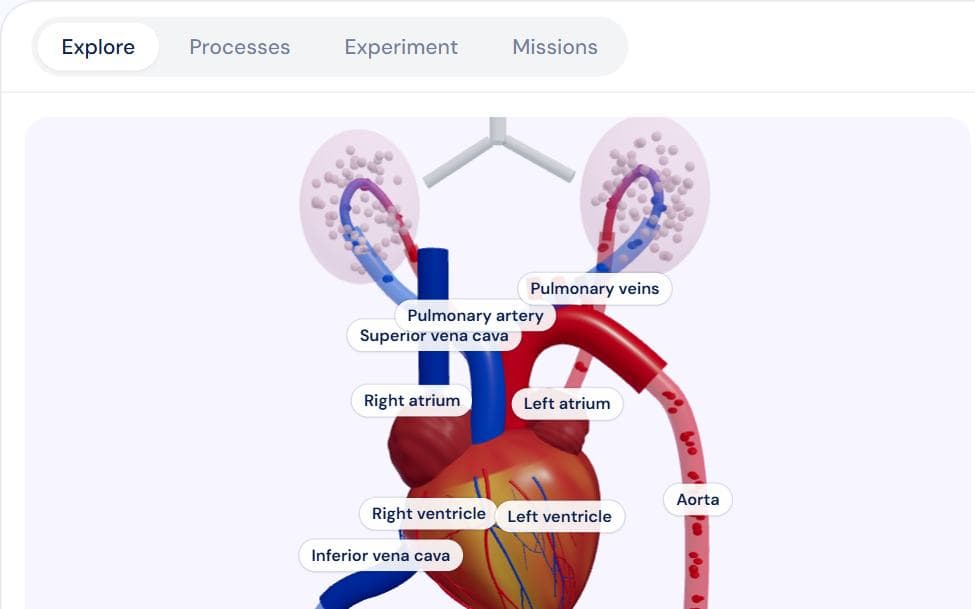
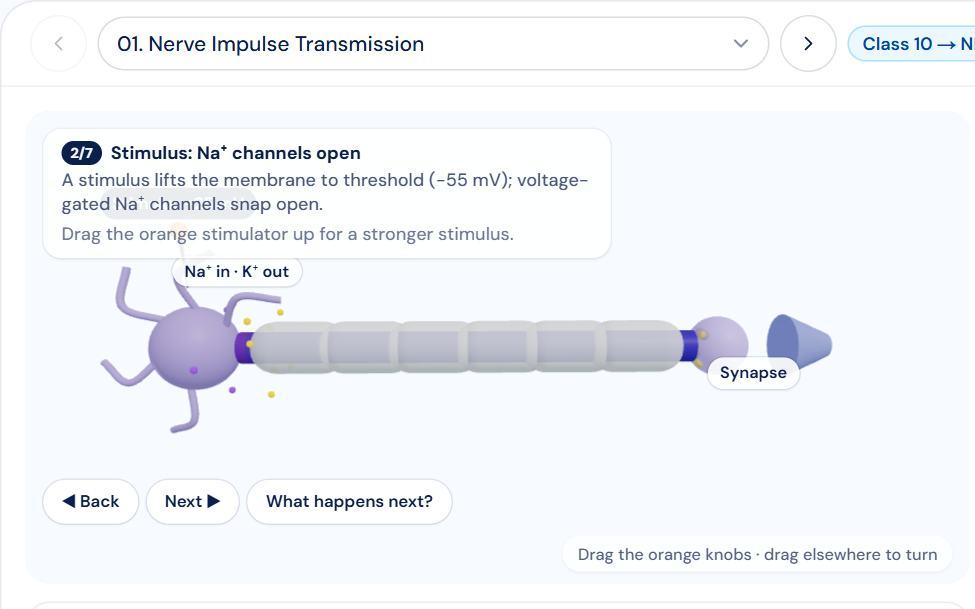
Human physiology: a nerve impulse runs down a myelinated or bare axon, coloured by its membrane potential, with Na⁺ flowing in and K⁺ out, and crosses a synapse; a nephron filters blood while water, glucose, salt and urea are followed separately, with an ADH knob on the collecting duct and the renal threshold for glucose; the Heart lab's beating heart runs the cardiac cycle beside a live Wiggers diagram; an immune response goes from a cut to memory cells, with primary and secondary antibody curves; the ovary and uterus change together through the menstrual cycle under FSH, LH, estrogen and progesterone; and the counter-current mechanism builds the medulla's salt gradient.
Cell and molecular biology: a replication fork with helicase, primers, Okazaki fragments and ligase — where you can pair the bases yourself; transcription and translation, where the ribosome waits for you to bring the right tRNA; meiosis with crossing over and independent assortment; mitosis in animal and plant cells; and molecules crossing a membrane one at a time by diffusion, carriers, osmosis (a U-tube) and the Na⁺/K⁺ pump. Plant physiology: a chloroplast under a lamp you move, showing limiting factors; a potted plant transpiring beside a fan, with a potometer; the nitrogen cycle in a field; and a seedling bending to a lamp you drag round it, with Darwin's and Went's experiments. Genetics, evolution and ecology: pea crosses with a Punnett square, a gene you mutate base by base (including sickle-cell), peppered moths on sooty bark, fertilisation to implantation, and a bare rock becoming a forest.
Also covers: biology simulation, neet biology simulation, nerve impulse transmission, action potential, resting potential, depolarisation repolarisation, synapse neurotransmitter, saltatory conduction, urine formation, nephron simulation, glomerular filtration, selective reabsorption, tubular secretion, adh collecting duct, renal threshold glucose, cardiac cycle, wiggers diagram, heart valves lub dub, immune response, primary and secondary immune response, antibody production, b cell t cell, vaccination memory cells, menstrual cycle, fsh lh estrogen progesterone, ovulation lh surge, corpus luteum, counter current mechanism, loop of henle, vasa recta, dna replication, okazaki fragments, leading and lagging strand, helicase primase ligase, semiconservative replication, transcription and translation, central dogma, genetic code codon anticodon, protein synthesis simulation, meiosis, crossing over, independent assortment, mitosis, cell cycle, mitotic index, diffusion osmosis active transport, facilitated diffusion, sodium potassium pump, osmotic pressure, photosynthesis, light reaction calvin cycle, photolysis of water, limiting factors blackman, transpiration, ascent of sap, cohesion tension, stomata opening closing, potometer, nitrogen cycle, nitrogen fixation, rhizobium root nodules, nitrification denitrification, phototropism, auxin, went experiment, darwin coleoptile, mendelian genetics, punnett square, monohybrid dihybrid cross, incomplete dominance, mutation, sickle cell anaemia mutation, frameshift mutation, natural selection, peppered moth industrial melanism, fertilisation, cleavage morula blastocyst, implantation, ecological succession, pioneer species lichens, hydrarch xerarch.