Skip to content
Geometry · Mathematics

Angles Simulation: Protractor, Pairs, Parallel Lines

Every activity in GeoGebra's “Learn Angles” collection, rebuilt as 25 step-by-step labs: find the parts of an angle under a magnifying glass, name angles with letter tiles, spot acute, right, obtuse and straight angles in a 3D room where a clock, scissors, a laptop, a door and a book move by themselves, measure and draw with a protractor you drag and turn (with the step-by-step placement animated), play the angle-sense and hot-and-cold games, add adjacent angles, slide complementary and supplementary pairs together, spin vertical angles, explore the eight angles where a road crosses two parallel roads, find x, tear the corners off a triangle, split polygons into triangles, wrap radius-long strings round a circle, and convert degrees and radians. Each practice question allows three CHECKs, gives a hint after the second and the worked solution after the third.

Interactive virtual lab · no download · works on phones and laptops

Chapter
Lines & Angles
For
Class 5–11 · JEE Main
Time
~60 min

Angles Lab: Learn Angles Step by Step is a Pro simulation

Pro opens all 162 virtual labs — 800 simulations with guides and quizzes.

How to use it

  1. 1Pick a module from the list (25, in six groups, from Class 5 to Class 11); set your level at the top right.
  2. 2Most modules have two modes: Explore — drag the orange handles, the stage keeps moving by itself — and Practise, where you get three CHECKs per question, a hint after the second and the solution after the third.
  3. 3Use Predict before you look, then Derive, Questions, Practise and Compare.

What to notice

  • Name an angle with its vertex in the middle: ; alone only when one angle has its vertex at .
  • On a protractor read the scale that is 0 on the first arm; the other scale gives .
  • Complementary: sum ; supplementary: sum ; vertical angles are equal.
  • Parallel lines: corresponding and alternate angles are equal, co-interior angles add to — and each converse proves lines parallel.
  • Triangle: ; -gon: ; exterior angles of any polygon: .
  • rad ; with in radians.

For teachers

A ready-made teaching kit comes with this lab

  • Lesson plan

    50 min, 4 steps

  • Ask the class

    5 questions with answers

  • Quick quiz

    7 questions, printable

  • Key formulas

    6 formulas

About the Angles Lab: Learn Angles Step by Step simulation

The Angles Lab covers everything about angles from Class 5 to Class 11 in 25 short interactive labs, rebuilt from GeoGebra's “Learn Angles” collection. It starts with what an angle is — two rays (the arms) from one point (the vertex) — with a magnifying glass you slide over the figure to find all seven parts, and letter tiles to name an angle three ways: ∠ABC, ∠CBA, or ∠B when only one angle has its vertex at B. A dial shows acute, right, obtuse, straight and reflex angles, and a 3D room of everyday objects — a clock, scissors, a laptop, a door and a book, all moving by themselves — asks you to freeze each one and say what kind of angle it makes.

Measuring and drawing are done with a real protractor that you drag onto the vertex and turn onto an arm; the step-by-step solution slides it into place and lights up the right scale, the one that reads 0 on the first arm (the other scale gives 180° minus the angle, the slip behind “an obtuse angle of 37°”). There is an angle-sense game, played in degrees and in radians, which awards points for drawing or estimating without tools, and a hot-and-cold game. Pairs of angles come next: adjacent angles add, complementary and supplementary pairs slide together into a right angle or a straight line, vertical angles are shown equal by spinning one half a turn, and “find x” drills turn each rule into an equation.

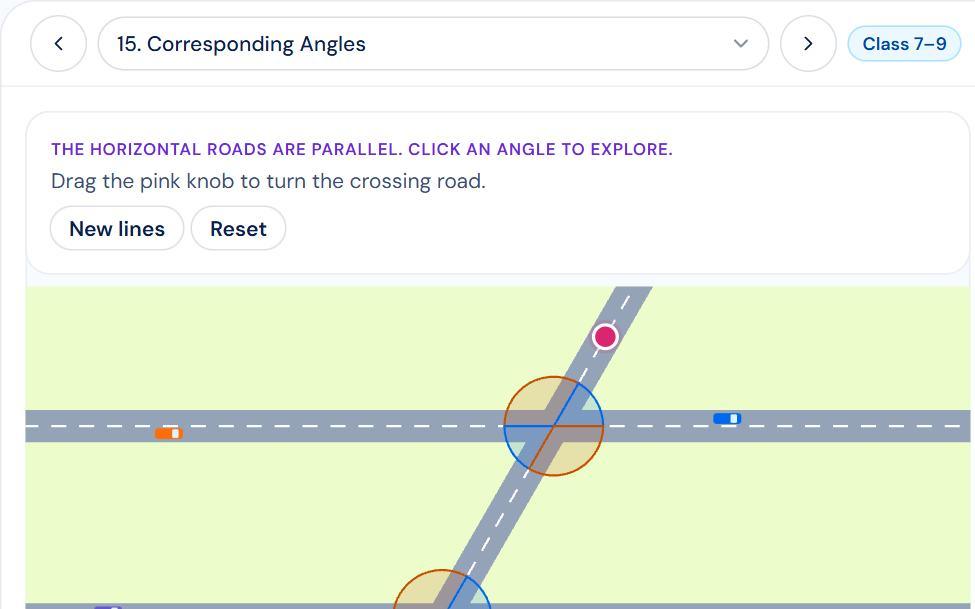
With parallel lines, the lab uses GeoGebra's picture of two parallel roads crossed by a third, with cars driving along them: click any of the eight angles and its partner lights up, while a copy slides along the crossing road (corresponding angles), spins half a turn about the midpoint (alternate angles) or moves across to form a straight line (co-interior angles). Then come the converse — which lines must be parallel — the triangle whose corners tear off and line up into 180°, polygons split into n − 2 triangles, the exterior-angle walk that turns exactly 360°, and radians: a string as long as the radius wraps round the circle, π of them fill a semicircle, and a conversion table fills in as you visit angles. Every practice question gives three CHECKs, a hint after the second and the worked solution after the third.

Also covers: angles, lines and angles, lines and angles class 7, lines and angles class 9, parts of an angle, vertex and arms, naming angles, types of angles, acute obtuse right straight reflex angle, angles around us, measuring angles with a protractor, how to use a protractor, drawing angles with a protractor, estimating angles, angle game, adjacent angles, complementary angles, supplementary angles, linear pair, vertically opposite angles, vertical angles, find the value of x angles, parallel lines and a transversal, corresponding angles, alternate interior angles, alternate exterior angles, co-interior angles, same side interior angles, converse of corresponding angles, angle sum property of a triangle, exterior angle property, angle sum of a polygon, exterior angles of a polygon, missing angle of a polygon, what is a radian, degree to radian conversion, radian measure class 11, arc length s = r theta, geogebra angles.

Frequently asked questions

How do you measure an angle with a protractor?

Put the protractor's centre mark exactly on the vertex, turn it so its 0 line lies along one arm, then follow the scale that reads 0 on that arm round to where the other arm crosses it. A protractor has two scales running in opposite directions; reading the wrong one gives 180° minus the true angle, so check that an angle that looks acute reads less than 90°.

What is the difference between complementary and supplementary angles?

Two angles are complementary when they add to 90° and supplementary when they add to 180°. They do not have to be next to each other. Placed side by side, complementary angles make a right angle and supplementary angles make a straight line. The complement of 32° is 58°; its supplement is 148°.

Which angles are equal when a transversal cuts two parallel lines?

Corresponding angles (in the same position at the two crossings), alternate interior angles and alternate exterior angles (on opposite sides of the transversal) are equal, and vertical angles at each crossing are equal. Co-interior (same-side interior) angles and linear pairs are not equal but add to 180°. Each of these properties also works backwards: if corresponding angles are equal, the lines are parallel.

Why do the angles of a triangle add up to 180°?

Draw a line through one vertex parallel to the opposite side. The two angles it makes with the other sides are alternate angles, so they equal the triangle's other two angles. Together with the angle at that vertex they fill a straight line, 180°. The lab shows this by tearing off two corners and turning each half a turn about the midpoint of a side so they land on that line.

What is a radian?

One radian is the angle at the centre of a circle that cuts off an arc exactly as long as the radius. A semicircle's arc is π radius-lengths, so π radians = 180° and 1 radian ≈ 57.3°. To convert degrees to radians multiply by π/180; to convert back multiply by 180/π. With θ in radians the arc length is simply s = rθ.