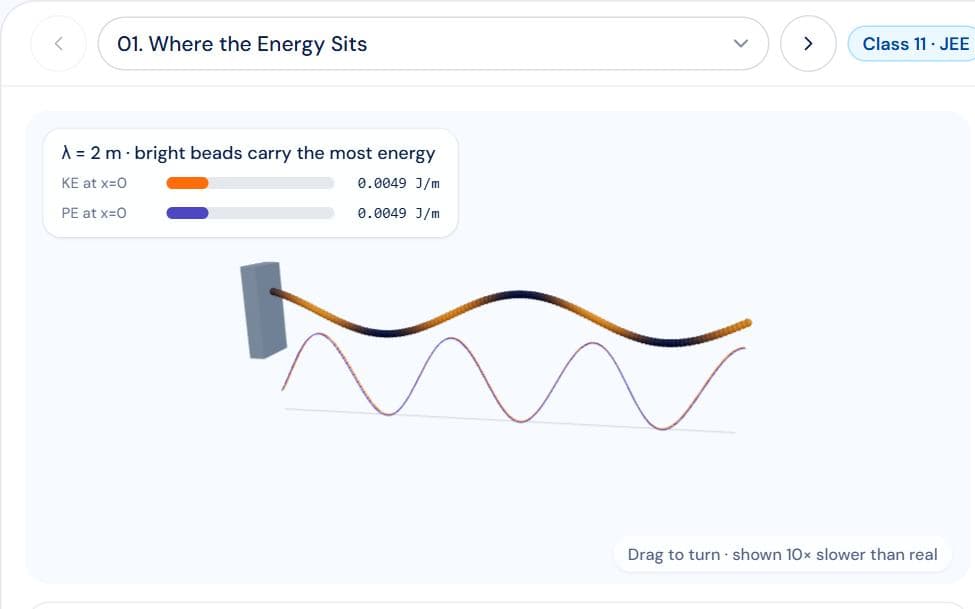
About the Energy of a Travelling Wave simulation
A wave on a string carries energy, but where on the wave is it? This 3D energy of a travelling wave simulation makes each bead glow by the energy it holds and draws the kinetic and stretch energy per metre underneath as the wave runs. The answer surprises most students: both kinds of energy peak where the string crosses its rest line, where it moves fastest and slopes most steeply, while at a crest a bead is momentarily still and the string there is flat — no energy at all.
This is the difference between a travelling wave and a single mass on a spring, where kinetic and potential energy swap. On the string they are equal at every point, both ½μω²A²cos²(kx − ωt), because the tension T = μv² makes Tk² equal μω². The second module turns that into the power a wave delivers, P = ½μω²A²v: double the amplitude or the frequency and the power goes up four times. Change amplitude, frequency, speed and mass per metre, predict, derive and practise numericals at JEE level.
Also covers: energy of a wave, energy carried by a wave on a string, power of a wave, intensity of wave, kinetic energy density, potential energy density, ½μω²a²v, power proportional to amplitude squared, strain in a wave, class 11 waves, jee waves energy.