Skip to content
Heat & Matter · Physics

Thermal Properties of Matter Simulation: 50 3D Labs

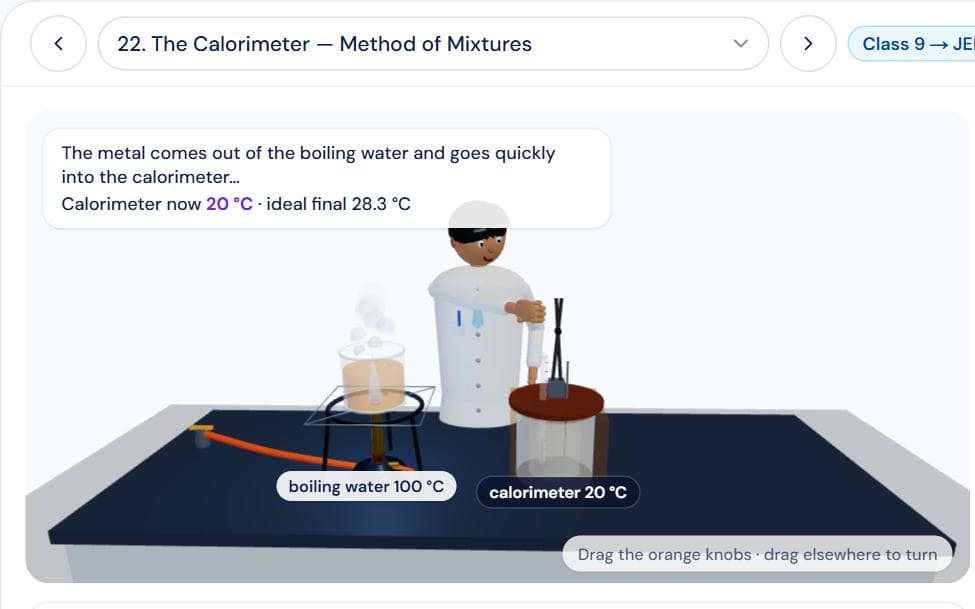
The whole NCERT chapter as one bench: fifty experiments, each acted out in 3D by a demonstrator in a lab coat — a finger dipped in hot water and snatched back, a hot block lifted off a Bunsen burner with tongs and lowered into a calorimeter, a thermometer carried from bath to bath. Thermometry, gas laws, expansion, water's 4 °C anomaly, specific heat, calorimetry, phase changes and phase diagrams, conduction, convection, radiation, blackbody laws, Newton's cooling, and a design challenge that uses all of it.

Interactive virtual lab · no download · works on phones and laptops

Chapter
Thermal Properties of Matter
For
Class 7–12 · JEE · NEET
Time
~60 min

Thermal Properties of Matter Lab is a Pro simulation

Pro opens all 152 virtual labs — 693 simulations with guides and quizzes.

How to use it

  1. 1Pick an experiment from the list (50), grouped like the chapter; set your level at the top right.
  2. 2Press play to watch the demonstrator do it; drag the orange knobs or use the sliders to change it.
  3. 3Use Predict before you look, then Derive, Questions, Practise and Compare.

What to notice

  • Heat flows from hot to cold until the temperatures match; the final temperature leans towards the larger heat capacity.
  • Temperature stays put while a substance melts or boils: the heat goes into the change of state.
  • Water is densest at 4 °C, so a lake freezes from the top and the fish survive below.
  • Conduction, convection and radiation each have their own law: H = kAΔT/L, H = hAΔT, H = eσAT⁴.
  • A body cools exponentially towards its surroundings: ln(T − Tₛ) falls in a straight line.

For teachers

A ready-made teaching kit comes with this lab

  • Lesson plan

    49 min, 4 steps

  • Ask the class

    5 questions with answers

  • Quick quiz

    6 questions, printable

  • Key formulas

    7 formulas

About the Thermal Properties of Matter Lab simulation

The Thermal Properties of Matter Lab is the whole Class 11 NCERT chapter as one virtual lab: fifty experiments in the chapter's order, each acted out in 3D by a demonstrator in a lab coat. Dip a finger in hot water and watch it jerk back; lift a hot block off a Bunsen burner with tongs and lower it into water; carry a thermometer from melting ice to steam and mark its scale; pump the air out of a bell jar until warm water boils; hang weights on a wire over a block of ice and watch it cut through without splitting it.

The modules follow the chapter: temperature and thermometry (thermal equilibrium, calibrating a thermometer, temperature scales, absolute zero from a gas thermometer, the resistance thermometer), the gas laws, linear, area and volume expansion with bimetallic strips, thermal stress and measurement errors, water's 4 °C anomaly and frozen lakes, specific heat and calorimetry, changes of state, phase diagrams of water and carbon dioxide, conduction, convection and radiation, blackbody radiation with Wien's and Stefan's laws, and Newton's law of cooling.

Every experiment has a Predict question before you watch, the derivation of the law, concept questions at Class 9, Class 11 · JEE Main and JEE Advanced level, and practice numericals. The last module, Thermal Engineer, asks you to keep a sun-baked room cool on a small air conditioner using everything in the chapter.

Also covers: thermal properties of matter, thermal properties of matter simulation, class 11 physics chapter 10, heat and temperature, thermal equilibrium, thermometer, temperature scales, absolute zero, gas thermometer, resistance thermometer, boyle's law, charles' law, ideal gas equation, thermal expansion, linear expansion, area expansion, volume expansion, bimetallic strip, thermal stress, anomalous expansion of water, why lakes freeze from the top, specific heat capacity, calorimetry, calorimeter, latent heat, heating curve, regelation, boiling point and pressure, pressure cooker, sublimation, phase diagram, triple point, conduction, thermal conductivity, convection, sea breeze land breeze, radiation, blackbody radiation, wien's displacement law, stefan boltzmann law, newton's law of cooling, thermos flask, jee thermal physics, neet thermal properties.

Frequently asked questions

What is the difference between heat and temperature?

Temperature tells how hot a body is — it measures the average kinetic energy of its particles. Heat is energy that flows from one body to another because their temperatures differ. A spark is very hot but carries almost no heat; a bucket of warm water is cooler but holds far more thermal energy.

Why does a lake freeze from the top and not the bottom?

Water is densest at 4 °C. As the surface cools in winter, the cold water sinks until the whole lake reaches 4 °C. After that, colder water is lighter and stays on top, where it freezes. Ice floats and insulates the water below, which stays near 4 °C, so fish survive the winter.

Why does food cook faster in a pressure cooker?

Water boils when its vapour pressure equals the pressure above it. The cooker traps steam, raising the pressure to about two atmospheres, so the water boils at about 120 °C instead of 100 °C, and food cooks much faster. On a mountain the opposite happens: lower pressure, lower boiling point, slower cooking.

How does a thermos flask keep tea hot?

It blocks all three modes of heat transfer. The vacuum between its double glass walls stops conduction and convection; the silvered walls reflect infrared and emit very little, cutting radiation; and the stopper blocks conduction, convection and evaporation through the top.

How do you find the cooling constant in Newton's law of cooling?

Record the temperature of a cooling body at regular intervals, then plot ln(T − Tₛ) against time. Newton's law predicts a straight line, ln(T − Tₛ) = ln(T₀ − Tₛ) − kt, so the slope of the best-fit line is −k.