Skip to content
Heat & Matter · Physics

Thermal Expansion: 5 Experiments in 3D Simulation

Five classic demonstrations of thermal expansion in 3D: a plate whose hole grows when heated, coloured liquid in a glass tube that dips before it rises, the ball-and-ring, railway rails that need a gap (or buckle), and a cube floating deeper as the liquid warms. Every one is driven by a burner and checked against ΔL = LαΔT.

Interactive virtual lab · no download · works on phones and laptops

Chapter
Thermal Properties of Matter
For
Class 7–11 · JEE · NEET
Time
~25 min

Thermal Expansion: Five Experiments is a Pro simulation

Pro opens all 152 virtual labs — 693 simulations with guides and quizzes.

How to use it

  1. 1Pick a module from the list (5); set your level at the top right for more controls.
  2. 2Set the temperature on each burner; drag the orange knobs where shown. The stage exaggerates the change so you can see it.
  3. 3Use Predict before you look, then Derive, Questions, Practise and Compare.

What to notice

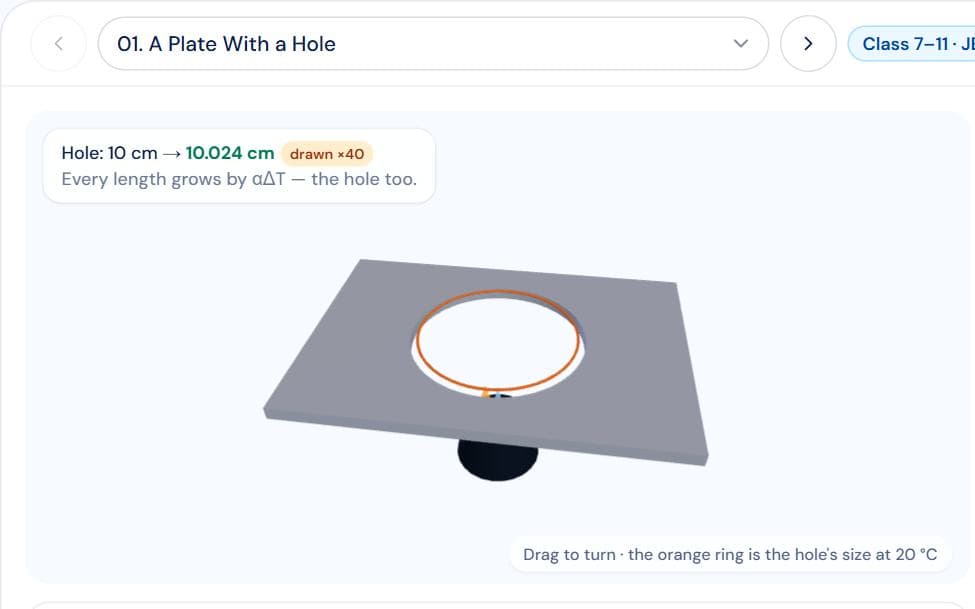
  • A hole in a plate grows as if it were made of the same metal.
  • The glass warms first, so the liquid level dips before it rises: γ_real = γ_apparent + γ_glass.
  • Heat the ring, not just the ball, to get a hot ball through.
  • Thermal stress YαΔT doesn't depend on length; gaps prevent it.
  • If the liquid expands more than the solid, a floating body sinks deeper.

For teachers

A ready-made teaching kit comes with this lab

  • Lesson plan

    28 min, 4 steps

  • Ask the class

    4 questions with answers

  • Quick quiz

    6 questions, printable

  • Key formulas

    4 formulas

About the Thermal Expansion: Five Experiments simulation

Things grow when they are heated, but the effects can be surprising. This 3D thermal expansion simulation runs five classic experiments, each heated by a burner. A metal plate with a hole is heated: the hole grows rather than shrinks, because every length on the plate grows by the same fraction. A flask of coloured liquid with a narrow tube goes into hot water: the level first dips, because the glass warms first, and then rises — the difference between real and apparent expansion.

The ball-and-ring experiment shows a ball that passes through a ring when cold, sticks when heated, and passes again when the ring is heated too. Railway rails need a gap of LαΔT at each joint; without enough gap they are squeezed with a thermal stress YαΔT that buckles the track. And a cube floating in a liquid sinks deeper as both warm, if the liquid expands more than the solid. Expansion is tiny, so each stage draws the change exaggerated and says by how much, while every number on the page is the true one.

Also covers: thermal expansion, linear expansion, area expansion, volume expansion, coefficient of linear expansion, hole in a heated plate, ball and ring experiment, railway track gap, thermal stress, apparent expansion of liquid, real and apparent expansion, floating body on heating, β = 2α, γ = 3α, class 11 thermal properties, jee thermal expansion.

Frequently asked questions

Does a hole in a metal plate get bigger or smaller when heated?

Bigger. Every length on the plate, including the diameter of the hole, increases by the same fraction αΔT, as if the hole were filled with the same metal. The plate expands like an enlarged photograph.

Why does the liquid level in a flask first fall when it is heated?

The glass is heated first and expands, so the flask's volume grows before the liquid inside has warmed. The level drops a little, then rises as the liquid warms and expands more than the glass. The rise you see is the apparent expansion, γ_real − γ_glass.

Why are gaps left between railway rails?

A rail grows by LαΔT in summer — about 6 mm for a 12.5 m steel rail warming by 40 °C. Without a gap it cannot expand and is put under a thermal stress YαΔT, about 96 MPa, which can buckle the track.

What happens to a floating object when the liquid and object are heated?

The fraction submerged is ρ_solid/ρ_liquid. If the liquid expands more than the solid, its density falls faster and the object sinks deeper; at a high enough temperature it can sink completely. If the solid expands more, it rises.