Skip to content
Electronics · Physics

Solar Cell 3D Simulation: I–V Curve & Maximum Power

How a solar cell works and how to get the most from it, in 3D. Photons make electron–hole pairs that the junction's field sweeps apart; drag a lamp closer or tilt the panel and watch the I–V curve move; turn the load knob to find the maximum power point; and wire cells in series or parallel and shade one to see a whole string sag.

Interactive virtual lab · no download · works on phones and laptops

Chapter
Semiconductor Electronics
For
Class 12 · JEE · NEET
Time
~25 min

Solar Cell is a Pro simulation

Pro opens all 152 virtual labs — 693 simulations with guides and quizzes.

How to use it

  1. 1Pick a module from the list (4); set your level at the top right for more controls.
  2. 2Drag the lamp (orange knob) to change the light, the panel's knob to tilt it, and tap cells to shade them.
  3. 3Use Predict before you look, then Derive, Questions, Practise and Compare.

What to notice

  • Only photons with energy above the band gap (1.12 eV for silicon, λ < 1107 nm) make current.
  • The short-circuit current is proportional to the light; the open-circuit voltage only grows logarithmically.
  • Power is zero at both ends of the curve; the best load sits at the knee.
  • In series, one shaded cell limits the whole string's current.

For teachers

A ready-made teaching kit comes with this lab

  • Lesson plan

    28 min, 4 steps

  • Ask the class

    4 questions with answers

  • Quick quiz

    6 questions, printable

  • Key formulas

    5 formulas

About the Solar Cell simulation

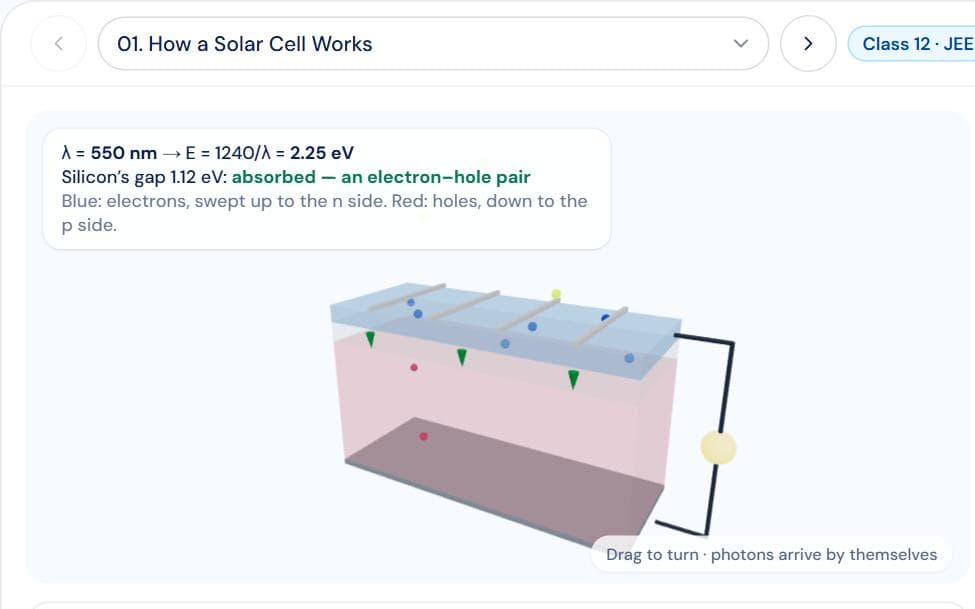
A solar cell is a p–n junction made to catch light. This 3D solar cell simulation starts inside one: photons fall onto a thin n-layer above a thicker p-layer, and any photon with more energy than silicon's band gap of 1.12 eV (wavelength below about 1107 nm) frees an electron and leaves a hole. The junction's built-in electric field sweeps the electron up to the n side and the hole down to the p side, and the contacts deliver them round the circuit to light a bulb — no battery needed. Infrared photons below the gap pass straight through.

Then the lab moves to the bench and gets hands-on. Drag the lamp closer and watch the short-circuit current follow the light (inverse-square law) while the open-circuit voltage hardly moves; tap the tilt chip to angle the panel away. Turn the load to find the maximum power point at the knee of the I–V curve, with the fill factor and efficiency worked out live. Finally wire four cells in series or parallel and shade one: in series a single shaded cell drags down the whole string's current, which is why real panels carry bypass diodes.

Also covers: solar cell, photovoltaic cell, solar cell i-v characteristics, open circuit voltage, short circuit current, maximum power point, fill factor, efficiency of solar cell, p-n junction solar cell, band gap of silicon, electron hole pair, solar panel series parallel, shading a solar panel, inverse square law light, class 12 semiconductor devices, jee semiconductors.

Frequently asked questions

How does a solar cell work?

Light with enough energy creates electron–hole pairs in the silicon. The electric field in the depletion region of the p–n junction pushes electrons to the n side and holes to the p side. This separation of charge produces a voltage, and when a load is connected a current flows through it.

What is the I–V characteristic of a solar cell?

It is the curve of current against voltage under light. It starts at the short-circuit current I_sc when V = 0, stays nearly flat, then falls sharply to zero at the open-circuit voltage V_oc. It lies in the fourth quadrant of a diode's characteristic because the cell supplies power.

What is the maximum power point of a solar cell?

The point on the I–V curve where the product V × I is largest, at the knee of the curve. Power is zero at both short circuit and open circuit. The load that draws maximum power is R = V_mp/I_mp; inverters track this point as the light changes.

Why does shading one cell reduce the output of a whole panel?

Cells in a panel are mostly joined in series, so the same current must flow through every cell. A shaded cell can supply only a small current, and it limits the current of the whole string. Bypass diodes let current go around a shaded group.