Skip to content
Mechanics · Physics

Rotational Motion 3D Simulation: Torque, Inertia & Rolling

Eight 3D experiments from torque to JEE Advanced: slide your hand along a wrench and aim the push until the stuck nut turns; race a ring, disc, shell and sphere with their mass shown as beads; drag the masses on a spinning platform in and watch ω rise while L stays fixed; see the velocity of every point of a rolling wheel and the cycloid of its rim; a heavy pulley whose two tensions differ; a hinged rod that outruns a coin on its tip; the spool that rolls away while you pull it towards you; and a ball striking a hinged rod, with the centre of percussion.

Interactive virtual lab · no download · works on phones and laptops

Chapter
System of Particles and Rotational Motion
For
Class 8–12 · JEE · NEET
Time
~35 min

Rotational Motion Lab is a Pro simulation

Pro opens all 152 virtual labs — 693 simulations with guides and quizzes.

How to use it

  1. 1Pick a module from the list (8, in five groups); set your level at the top right for more controls.
  2. 2Drag the orange knobs in the 3D scene — the hand, the masses, the rod's tip, the string — or type exact values.
  3. 3Use Predict before you press play, then Derive, Questions, Practise (fresh numericals each time) and Compare.

What to notice

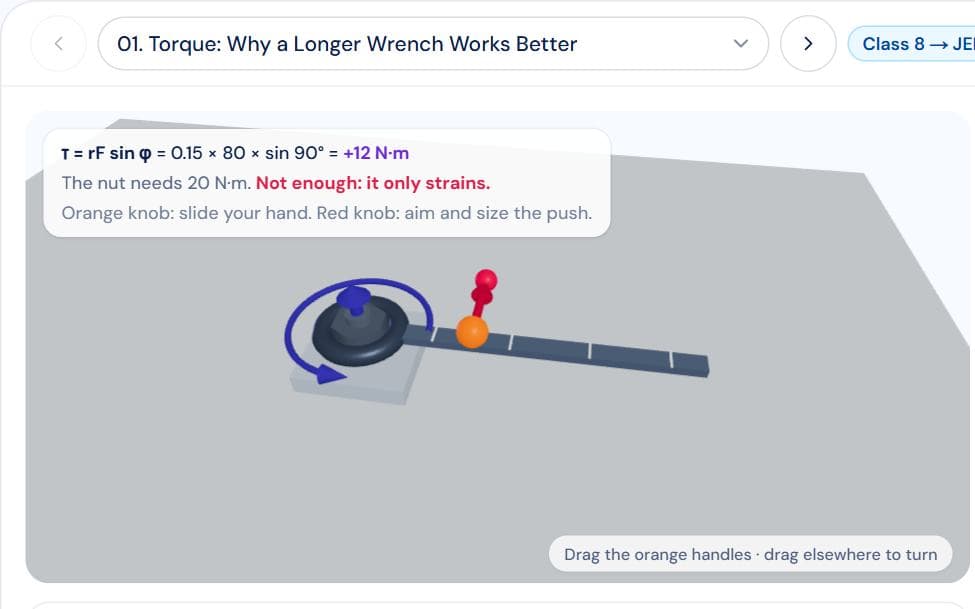
  • τ = rF sin φ: distance from the axis and the square part of the force both matter.
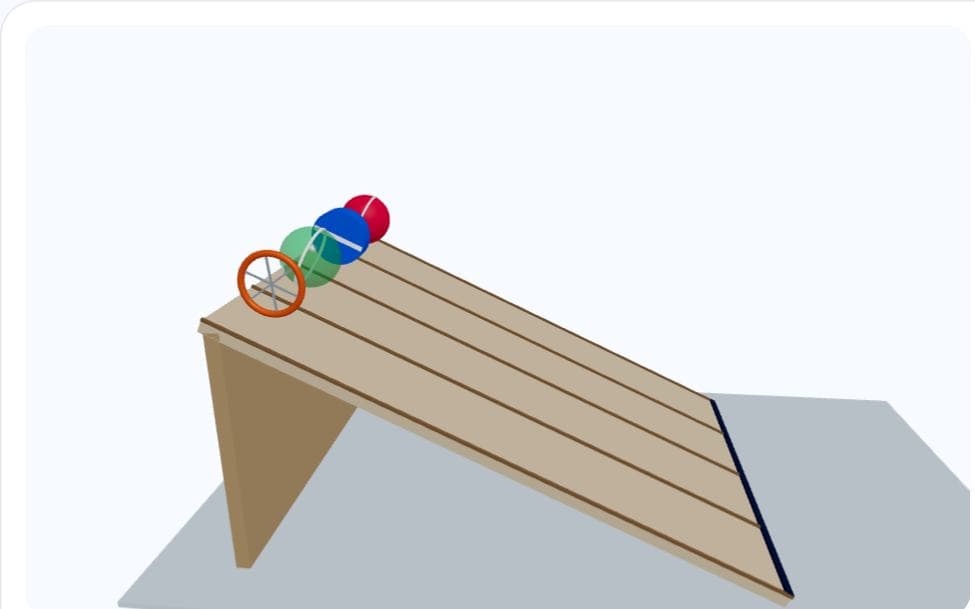
  • Rolling down a ramp, a = g sin θ/(1 + I/mR²): the solid sphere wins, the ring is last, mass cancels.
  • With no external torque L = Iω is fixed; pulling mass in raises ω and the kinetic energy.
  • In pure rolling the contact point is at rest and the top moves at 2v.
  • Which way a spool rolls is set by the torque about the contact point, not by the direction of the pull.

For teachers

A ready-made teaching kit comes with this lab

  • Lesson plan

    35 min, 4 steps

  • Ask the class

    5 questions with answers

  • Quick quiz

    7 questions, printable

  • Key formulas

    9 formulas

About the Rotational Motion Lab simulation

System of Particles and Rotational Motion is the chapter most JEE aspirants find hardest to picture, because the same body moves forwards and spins at once. This Rotational Motion simulation lab builds each idea as a 3D experiment you can grab: slide your hand along a wrench and aim the push until a stuck nut gives; race a ring, a disc, a hollow sphere and a solid sphere down one ramp with their mass drawn as beads; drag the masses on a spinning platform towards the axis and watch it speed up while its angular momentum stays fixed.

Then the rolling and dynamics that JEE Main and Advanced test: the velocity of every point of a rolling wheel, seen from the ground and from the centre, with the cycloid its rim traces and the instantaneous axis at the contact point; a heavy pulley whose two string tensions differ; a hinged rod that falls faster than a coin resting on its tip; the spool that rolls away from you while you pull it towards you; and a ball striking a hinged rod, where angular momentum about the hinge is kept but linear momentum is not — except at the centre of percussion.

Each of the eight modules has a prediction question that hides the answer until you commit, a derivation, concept questions with hints (single, multiple-correct, assertion–reason, numeric and explain-in-words) and fresh practice numericals every time you ask.

Also covers: rotational motion, system of particles and rotational motion, torque, moment of force, lever arm, torque wrench, r cross f, moment of inertia, rolling race ring disc sphere, rolling without slipping, angular momentum, conservation of angular momentum, spinning skater, rotating platform, pure rolling, velocity of points on a rolling wheel, instantaneous axis of rotation, cycloid, massive pulley, tension in pulley with mass, falling rod, hinged rod, rod released from horizontal, hinge reaction, spool paradox, yo-yo spool, rolling direction of spool, collision with hinged rod, centre of percussion, angular impulse, jee advanced rotation.

Frequently asked questions

Why does a solid sphere roll down faster than a ring?

Both lose the same potential energy, but the ring keeps all its mass at the rim, so half of that energy goes into spinning it (I = mR²). The solid sphere keeps most of its mass near the axis (I = 2mR²/5), so only 2/7 goes into spin and the rest into speed. Mass and radius cancel, so any solid sphere beats any ring.

Why does a skater spin faster when she pulls her arms in?

The ice exerts almost no torque about her vertical axis, so her angular momentum L = Iω stays the same. Pulling her arms in lowers I, so ω has to rise. Her kinetic energy L²/2I goes up too — the extra comes from the work her arms do pulling inwards.

Why is the contact point of a rolling wheel at rest?

The contact point moves forwards with the centre at v and backwards from the spin at Rω. Rolling without slipping means these cancel, v = Rω, so at that instant the point is at rest on the ground. That is also why static friction does no work on a body that rolls without slipping.

Which way does a spool roll when you pull its string?

Take torques about the point where it touches the floor: friction and the normal force act there and have none, so only the string's line matters. If the line passes above that point the spool rolls towards you, below it away from you, and through it — when cos φ = r/R for a string from under the axle — not at all.

Is linear momentum conserved when a ball hits a hinged rod?

No. The hinge can push on the rod during the impact, so the system's linear momentum changes. Angular momentum about the hinge is conserved, because the hinge's force acts at the hinge and has no moment about it. Hit at 2L/3 from the hinge — the centre of percussion — the hinge feels nothing and linear momentum is conserved as well.