Skip to content
Mechanics · Physics

Rocket in Empty Space: Momentum 3D Simulation

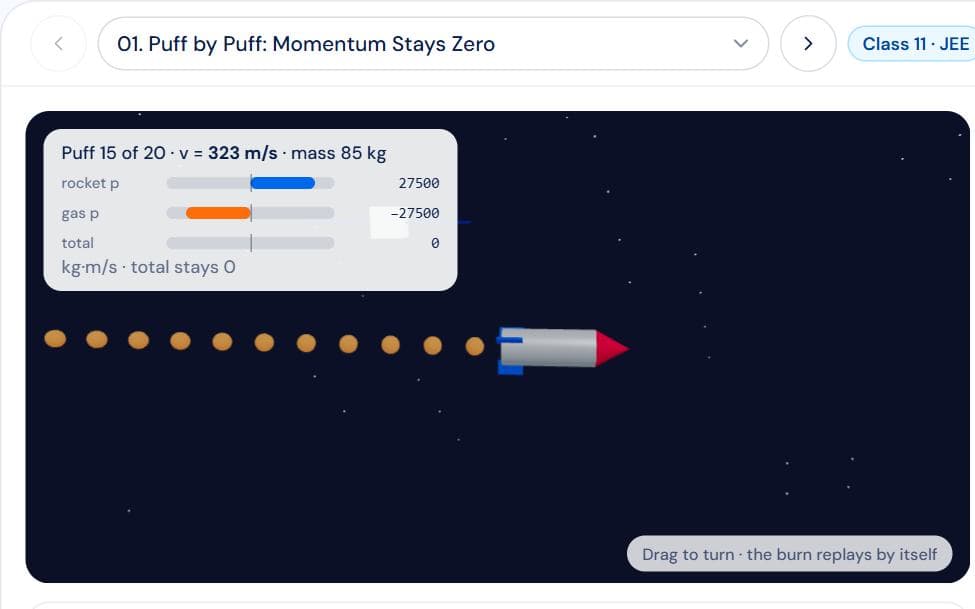
A rocket floats beside a satellite in deep space and burns its fuel as separate puffs of gas, in 3D. Momentum bars for the rocket and the gas grow equal and opposite; later puffs add more speed than early ones; smaller puffs approach the smooth u ln(m₀/m₁); and on a launch pad, thrust must beat the weight.

Interactive virtual lab · no download · works on phones and laptops

Chapter
System of Particles
For
Class 11 · JEE
Time
~15 min

The Rocket in Empty Space is a Pro simulation

Pro opens all 152 virtual labs — 693 simulations with guides and quizzes.

How to use it

  1. 1Pick a module from the list (3); set your level at the top right for more controls.
  2. 2Set the exhaust speed, fuel, puff size and empty mass, then press play.
  3. 3Use Predict before you look, then Derive, Questions, Practise and Compare.

What to notice

  • Rocket + gas is isolated: the total momentum stays zero at every moment.
  • Each puff adds Δv = Δm·u/m — more as the rocket gets lighter.
  • Smaller puffs give slightly more speed, approaching u ln(m₀/m₁).
  • Leaving the ground needs thrust u·dm/dt greater than the weight.

For teachers

A ready-made teaching kit comes with this lab

  • Lesson plan

    21 min, 4 steps

  • Ask the class

    3 questions with answers

  • Quick quiz

    5 questions, printable

  • Key formulas

    3 formulas

About the Rocket in Empty Space simulation

How can a rocket speed up in empty space, with nothing to push against? This 3D rocket in empty space simulation floats a small rocket beside a satellite and burns its fuel as separate puffs of hot gas, each thrown backwards at speed u relative to the rocket. Momentum bars for the rocket and for the gas grow equal and opposite, and the total stays zero at every moment, because rocket plus gas is an isolated system.

Each puff adds Δv = Δm·u/m, so later puffs, pushing a lighter rocket, add more speed than early ones — from 20 m/s for the first to 24.7 m/s for the last in the starting case, which ends at 443.8 m/s. The second module races two rockets burning the same fuel in small and big puffs and shows the speeds approaching the smooth-burn rocket equation, v = u ln(m₀/m₁). The third puts the rocket on a launch pad: thrust u·dm/dt must beat the weight before it can lift off. A JEE variable-mass lab with predictions, derivations, questions and numericals.

Also covers: rocket propulsion, rocket in empty space, conservation of momentum rocket, variable mass system, rocket equation, tsiolkovsky, u ln m0/m, exhaust velocity, thrust, lift off condition, momentum of gas and rocket, class 11 system of particles, jee variable mass.

Frequently asked questions

How does a rocket move in space where there is no air to push against?

The rocket pushes the exhaust gas backwards and the gas pushes the rocket forwards (Newton's third law). Rocket and gas together form an isolated system, so their total momentum stays zero: the forward momentum of the rocket equals the backward momentum of the gas.

What is the rocket equation?

For a rocket that starts at rest and burns fuel smoothly, ejecting it at speed u relative to the rocket, the final speed is v = u ln(m₀/m₁), where m₀ is the starting mass and m₁ the final mass. It was first derived by Tsiolkovsky.

What is the thrust of a rocket?

Thrust = u × dm/dt, the exhaust speed times the rate at which mass is ejected. To leave the ground the thrust must be greater than the rocket's weight mg; the acceleration is then (u·dm/dt − mg)/m.