Skip to content
Electricity · Physics

Resistors in Series & Parallel: Class 10 Virtual Lab

Wire up two resistors marked 4 Ω and 6 Ω — first each alone, then in series, then in parallel — with a battery, plug key, rheostat, ammeter and voltmeter. Read the analog meters to their least counts, take three readings for each connection, and compare the measured series and parallel resistances with R₁ + R₂ and R₁R₂/(R₁ + R₂). The resistors are slightly off their labels, like real ones.

Interactive virtual lab · no download · works on phones and laptops

Chapter
Electricity · Class 10 Practical
For
Class 10 · CBSE practical
Time
~20 min

Equivalent Resistance Practical: Resistors in Series and Parallel is a Pro simulation

Pro opens all 152 virtual labs — 693 simulations with guides and quizzes.

How to use it

  1. 1Step through with Next; at “Readings” choose the connection.
  2. 2Close the key, slide the rheostat, read both meters (switch the large meter between them) and record.
  3. 3Take three readings per connection; the table and the result fill in.

What to notice

  • In series the resistances add: R_s = R₁ + R₂.
  • In parallel 1/R_p = 1/R₁ + 1/R₂, less than the smaller one.
  • A meter's least count is its range divided by its number of divisions.

For teachers

A ready-made teaching kit comes with this lab

  • Lesson plan

    25 min, 4 steps

  • Ask the class

    4 questions with answers

  • Quick quiz

    6 questions, printable

  • Key formulas

    3 formulas

About the Equivalent Resistance Practical: Resistors in Series and Parallel simulation

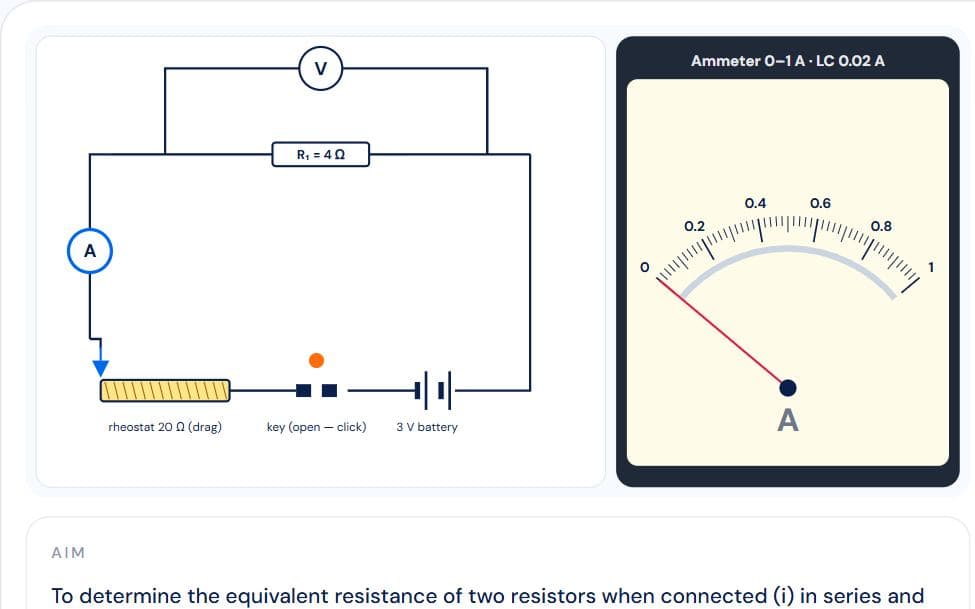
The CBSE Class 10 practical “to determine the equivalent resistance of resistors when connected in series and in parallel”, as an online virtual lab built on the circuit diagram you draw in your practical file: battery, plug key, rheostat, ammeter in series and voltmeter across the resistors.

You measure each resistor alone, then the series and parallel combinations, reading the analog ammeter and voltmeter to their least counts (0.02 A and 0.1 V). Three readings per connection give R = V/I; the result compares the measured equivalent resistances with R₁ + R₂ and R₁R₂/(R₁ + R₂).

Also covers: to determine equivalent resistance of resistors when connected in series and in parallel, resistors in series, resistors in parallel, equivalent resistance, ammeter voltmeter, least count of ammeter, least count of voltmeter, rheostat, class 10 practical, class 10 practicals, class 10 physics practical, class 10 science practical, cbse class 10 practical, physics practical class 10, virtual lab class 10, practical file.

Frequently asked questions

How is equivalent resistance found in the series and parallel practical?

For each connection, measure the potential difference across it and the current through it at a few rheostat settings; R = V/I, averaged over the readings.

Why is the equivalent resistance in parallel less than either resistor?

Each extra branch gives the current another path, so the combination lets more current through for the same voltage.

How do I find the least count of an ammeter?

Divide its range by the number of divisions: a 0–1 A ammeter with 50 divisions reads to 0.02 A.

Why is the voltmeter connected in parallel?

It measures the potential difference between two points, so it goes across them; its high resistance means it draws almost no current.