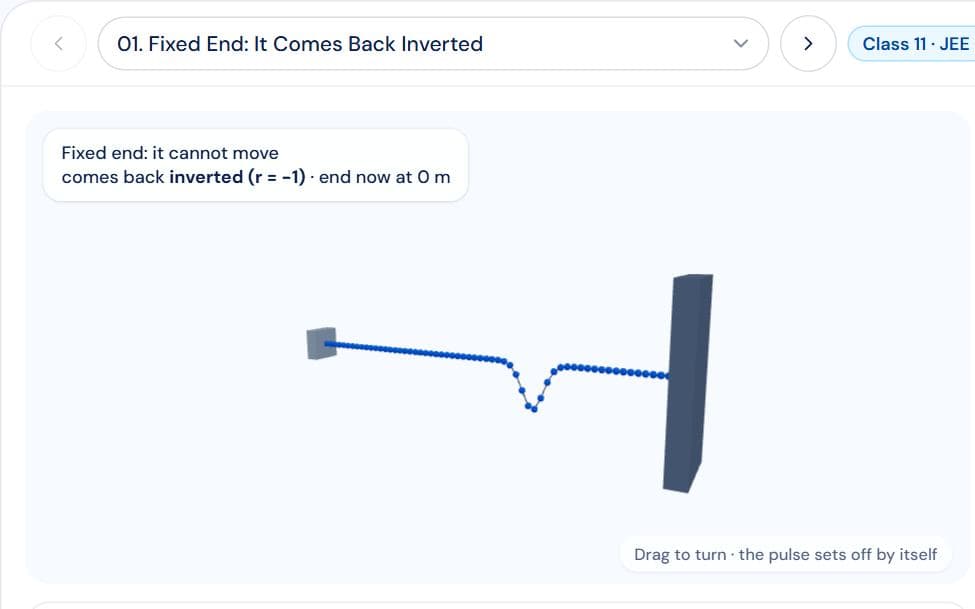
About the Reflection & Transmission of a Pulse simulation
What happens when a pulse on a string reaches the end? This 3D reflection and transmission of a pulse simulation sends a hump, triangle or square pulse along a string of beads into three different ends. At a fixed end — a clamp on a wall — it comes back upside down, because the wall pulls the string the other way. At a free end — a light ring sliding on a smooth rod — it comes back the right way up, and the ring overshoots to twice the pulse's height.
The third module joins two strings under the same tension. Going into a heavier, slower string, part of the pulse reflects inverted and part carries on upright but squeezed narrower; going into a lighter, faster string, the reflection is upright and the transmitted pulse is stretched wider and taller. Turn on the ghosts to see the incident and reflected pulses separately before they add up, and compare the heights with r = (v₂ − v₁)/(v₁ + v₂) and τ = 2v₂/(v₁ + v₂) — the method of images and the boundary conditions that JEE builds questions on.
Also covers: reflection of a pulse, fixed end reflection, free end reflection, phase change on reflection, pulse inverted, transmission at a boundary, light string to heavy string, reflection coefficient, transmission coefficient, impedance of a string, method of images, class 11 waves, jee waves.