Skip to content
Light & Optics · Physics

Refraction Through a Glass Prism: Class 10 Virtual Lab

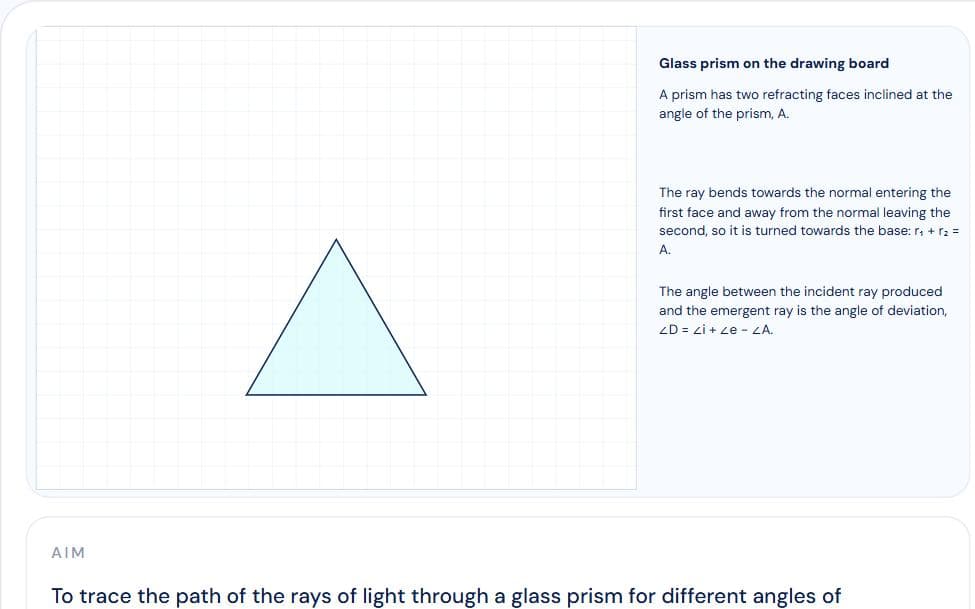
Trace the path of a ray through a 60° glass prism with four pins, exactly as in the lab: set the angle of incidence, fix P and Q, sight through the second face and line R and S up with the images, then measure the angle of emergence and the angle of deviation on your own lines. Three trials show the deviation changing with ∠i, its minimum when ∠i = ∠e, and a rough refractive index.

Interactive virtual lab · no download · works on phones and laptops

Chapter
Light: Reflection and Refraction · Class 10 Practical
For
Class 10 · CBSE practical
Time
~20 min

Glass Prism Practical: Tracing Rays Through a Prism is a Pro simulation

Pro opens all 152 virtual labs — 693 simulations with guides and quizzes.

How to use it

  1. 1Use Next to go through the practical; choose crown or flint glass at the top.
  2. 2Set ∠i and fix P and Q; drag R and S until they line up with the images in the eye view.
  3. 3Read ∠e and ∠D off the magnified protractors and record three trials.

What to notice

  • The emergent ray bends towards the base of the prism.
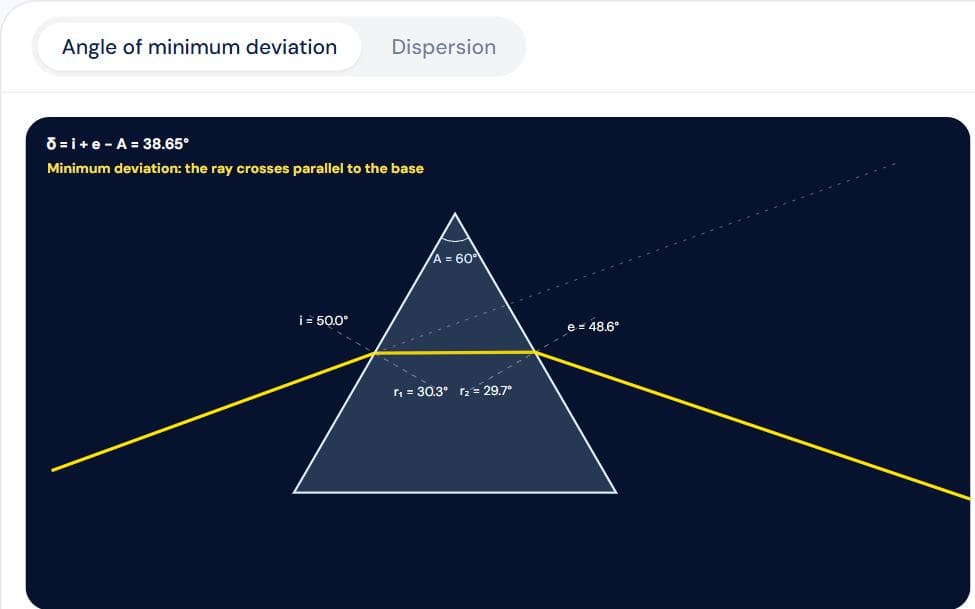
  • ∠D = ∠i + ∠e − ∠A.
  • ∠D falls and then rises as ∠i increases; it is least when ∠i = ∠e.

For teachers

A ready-made teaching kit comes with this lab

  • Lesson plan

    25 min, 4 steps

  • Ask the class

    4 questions with answers

  • Quick quiz

    6 questions, printable

  • Key formulas

    3 formulas

About the Glass Prism Practical: Tracing Rays Through a Prism simulation

The CBSE Class 10 practical “to trace the path of the rays of light through a glass prism”: draw the prism's outline, set an angle of incidence on the first face, fix two pins on the incident ray, sight through the second face and fix two more pins in line with their images, then measure the angle of emergence and the angle of deviation.

The simulation traces the light exactly through a 60° prism of crown or flint glass, but what you measure is what you drew: your pins, your lines, your protractor reading to 1°. Three trials at different angles show how the deviation changes and where it is smallest.

Also covers: tracing the path of the rays of light through a glass prism, refraction through prism, angle of deviation, angle of emergence, angle of prism, minimum deviation, prism experiment, class 10 practical, class 10 practicals, class 10 physics practical, class 10 science practical, cbse class 10 practical, physics practical class 10, virtual lab class 10, practical file.

Frequently asked questions

What is the angle of deviation in a prism?

The angle between the incident ray produced forward and the emergent ray produced backward — how much the prism has turned the light.

Why does the ray bend towards the base of the prism?

At the first face it bends towards the normal and at the second away from it; because the faces are inclined, both bends turn the ray the same way — towards the thicker base.

When is the deviation minimum?

When the ray passes through symmetrically, with ∠i = ∠e; for an equilateral prism the ray inside is then parallel to the base.

Why does a prism split white light but a glass slab does not?

Each colour bends by a slightly different amount. In a prism the colours leave in different directions; a slab's parallel faces send them out parallel again, overlapping.