Skip to content
Electricity · Physics

Ohm's Law V–I Graph: Class 10 Virtual Lab

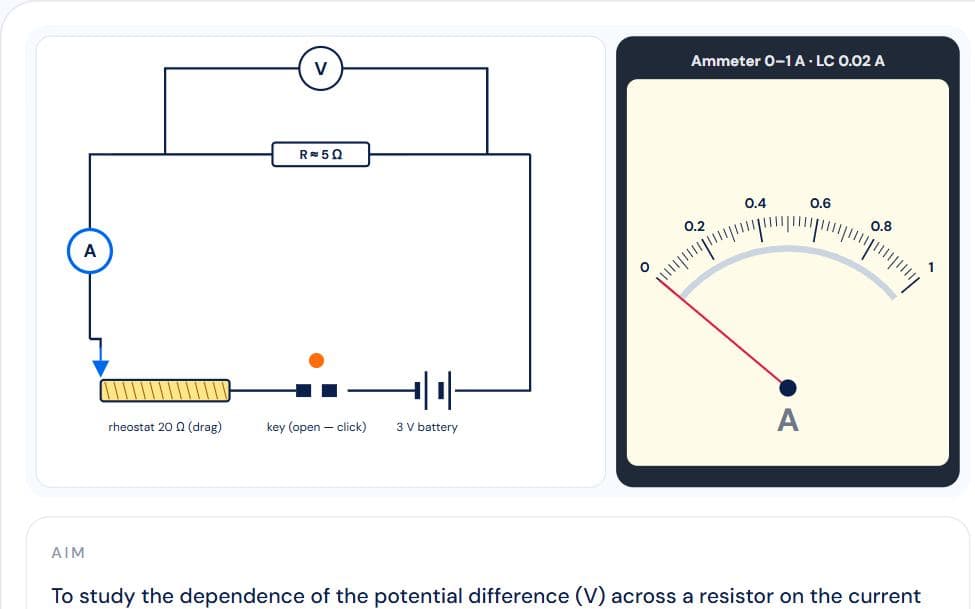
Study how the potential difference across a resistor depends on the current through it. Change the current with the rheostat and the number of cells, read the analog voltmeter and ammeter to their least counts, take five readings, and plot V against I: a straight line through the origin whose slope is the resistance. With the observation table, result, precautions and viva.

Interactive virtual lab · no download · works on phones and laptops

Chapter
Electricity · Class 10 Practical
For
Class 10 · CBSE practical
Time
~20 min

Ohm's Law Practical: V–I Graph of a Resistor is a Pro simulation

Pro opens all 152 virtual labs — 693 simulations with guides and quizzes.

How to use it

  1. 1Step through with Next; at “Five readings” set the cells and the rheostat.
  2. 2Close the key, read both meters and record; spread the readings out.
  3. 3Open “V–I graph” for the plot and its slope.

What to notice

  • V/I stays the same at every reading: Ohm's law.
  • The V–I graph is a straight line through the origin; its slope is R.
  • Keep the key open between readings so the resistor does not heat up.

For teachers

A ready-made teaching kit comes with this lab

  • Lesson plan

    25 min, 4 steps

  • Ask the class

    4 questions with answers

  • Quick quiz

    6 questions, printable

  • Key formulas

    2 formulas

About the Ohm's Law Practical: V–I Graph of a Resistor simulation

The CBSE Class 10 practical “to study the dependence of potential difference (V) across a resistor on the current (I) passing through it and determine its resistance; also plot a graph between V and I” — here as an online virtual lab.

Change the current with the rheostat and the number of cells, read the analog voltmeter and ammeter to their least counts, and take five readings. V/I comes out the same each time, and the V–I graph is a straight line through the origin whose slope is the resistance.

Also covers: dependence of potential difference across a resistor on current with graph, ohm's law experiment, v-i graph, v i graph, potential difference and current, resistance from graph, slope of v-i graph, class 10 practical, class 10 practicals, class 10 physics practical, class 10 science practical, cbse class 10 practical, physics practical class 10, virtual lab class 10, practical file.

Frequently asked questions

What is the shape of the V–I graph for a resistor?

A straight line through the origin, because V is directly proportional to I. Its slope is the resistance.

How do you find resistance from a V–I graph?

Take two points far apart on the best straight line and divide the change in V by the change in I.

Why should current be passed only while taking a reading?

Current heats the resistor; a hotter resistor has a higher resistance, so V/I would drift and the graph would curve.

Does every conductor obey Ohm's law?

No. A filament lamp's resistance rises as it heats, so its V–I graph curves; diodes conduct well in one direction only.