Skip to content
Mechanics · Physics

Moment of a Force: Same Force, Different Point Simulation

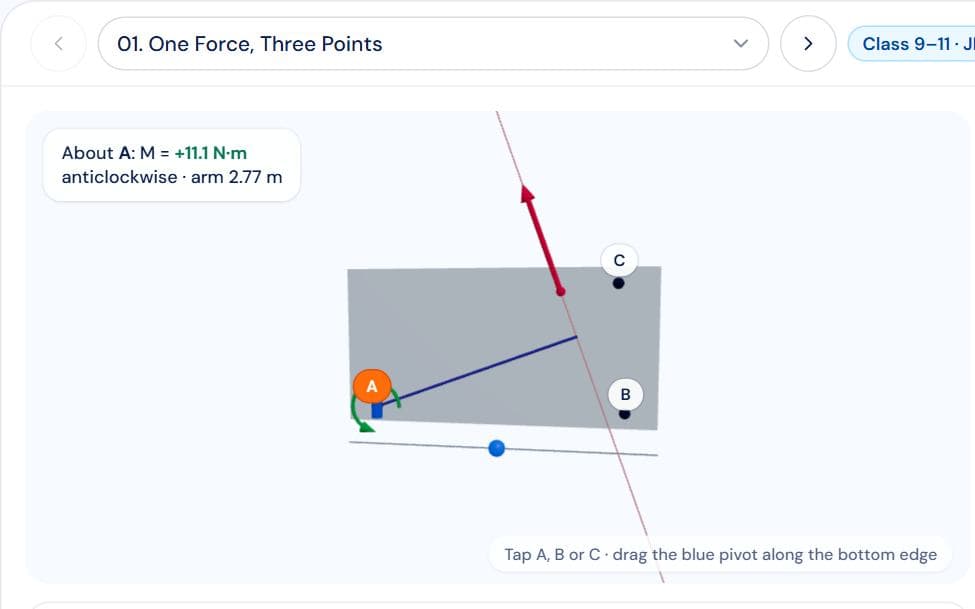
One force acts on a plate in 3D, and you pick the point to take moments about. Tap A, B or C, or drag the pivot along the edge and watch the moment trace a straight line through zero where it meets the line of action. Pin the plate and let go to see which way it really turns.

Interactive virtual lab · no download · works on phones and laptops

Chapter
System of Particles and Rotational Motion
For
Class 9–11 · JEE
Time
~15 min

Same Force, Different Point: The Sign of a Moment is a Pro simulation

Pro opens all 152 virtual labs — 693 simulations with guides and quizzes.

How to use it

  1. 1Pick a module from the list (3); set your level at the top right for more controls.
  2. 2Tap A, B or C on the plate, or drag the orange pivot; tap Pin to let the plate turn.
  3. 3Use Predict before you look, then Derive, Questions, Practise and Compare.

What to notice

  • A moment belongs to a force and a point together, never to the force alone.
  • About points on the line of action the moment is zero; it changes sign across it.
  • Along a straight edge the moment changes linearly.
  • M = rF sin θ: pull square to the wrench for the most turning.

For teachers

A ready-made teaching kit comes with this lab

  • Lesson plan

    22 min, 4 steps

  • Ask the class

    3 questions with answers

  • Quick quiz

    6 questions, printable

  • Key formulas

    4 formulas

About the Same Force, Different Point: The Sign of a Moment simulation

A moment is not a property of a force by itself — it belongs to a force and a chosen point together. This 3D moment of a force simulation puts a single force on a plate with three marked points, A, B and C. Tap each one and the same force gives a different moment, and even a different sign: anticlockwise about one point, clockwise about another. The moment arm (the perpendicular from the point to the line of action) and a curved arrow showing the sense update as you go.

Drag a pivot along the bottom edge and the moment traces a straight line on the graph, crossing zero exactly where the edge meets the force's line of action — press On the line of action to jump there. Then press Pin it here: the plate is pinned at that point and released, and it really turns the way the sign says, or not at all on the line of action. The last module is a spanner pulled at an angle, where only F sin θ turns the nut. A lab for Class 9 turning effect up to JEE torque.

Also covers: moment of a force, torque about a point, sign of torque, clockwise anticlockwise moment, line of action, moment arm, perpendicular distance, torque r cross f, pivot point, torque wrench, class 9 turning effect, class 11 rotational motion, jee torque.

Frequently asked questions

Why does the same force have different moments about different points?

A moment is force times the perpendicular distance from the point to the force's line of action, and that distance depends on the point. Points on opposite sides of the line of action also get opposite signs, because the force would turn the body opposite ways about them.

What is the moment of a force about a point on its line of action?

Zero. The perpendicular distance from the point to the line of action is zero, so the force has no turning effect about that point.

How does the angle of pull change the torque on a spanner?

Only the part of the force square to the handle turns it: τ = rF sin θ. Pulling at 90° gives the most torque, at 30° half as much, and pulling straight along the handle gives none.