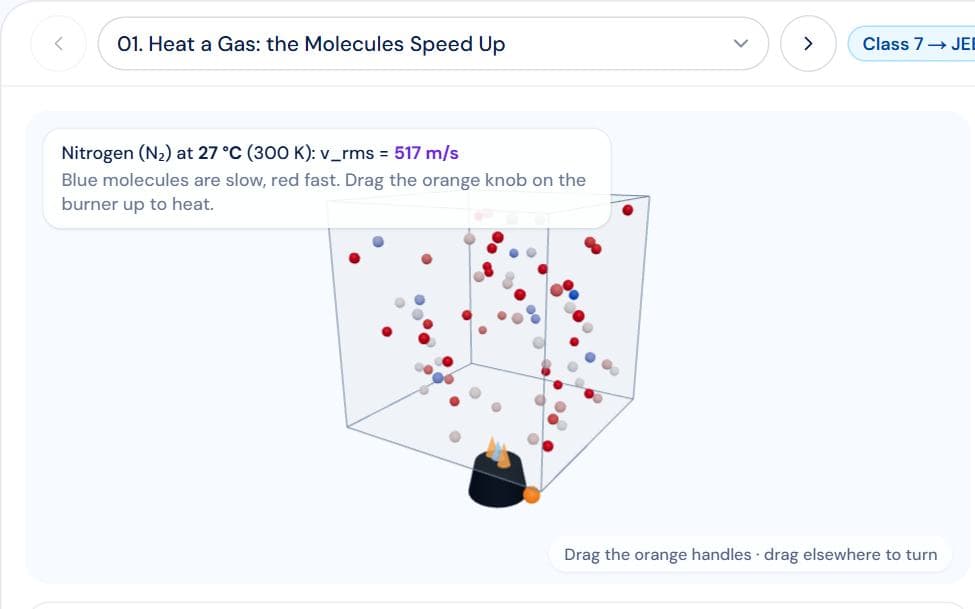
About the Thermal Energy & Molecular Motion simulation
What is heat, and what does a thermometer measure? This thermal energy and molecular motion simulation answers at the level of particles, in 3D. Heat a box of gas and its molecules — the same molecules — speed up; slow ones are drawn blue, fast ones red. Switch from nitrogen to helium at the same temperature and the lighter molecules move faster, because at one temperature every gas has the same average kinetic energy per molecule, (3/2)kT. For Class 11 the Maxwell distribution and the rms, average and most probable speeds sit alongside.
Then the difference between temperature and thermal energy: a small cup of hot tea is hotter than a big bucket of warm water, but the bucket holds far more energy and melts far more ice. Push a hot block against a cold one and watch the jiggling of their particles even out until both reach one temperature, the weighted average Σ mcT/Σ mc. And find out why a metal bench feels colder than a wooden one in the same park, though both are at the same temperature: metal pulls heat from your skin so fast that your skin's surface — which is what your nerves sense — gets much colder.
The four modules suit Class 7 science through Class 11 kinetic theory and thermal properties of matter, with predictions, derivations, questions and fresh numericals.
Also covers: thermal energy, molecular motion, temperature and kinetic energy, kinetic theory, particles move faster when heated, average kinetic energy 3/2 kt, rms speed, most probable speed, maxwell distribution, heat vs temperature, thermal energy vs temperature, heat capacity, specific heat, thermal equilibrium, zeroth law, hot and cold bodies in contact, why metal feels cold, thermal effusivity, contact temperature, class 7 heat, class 9 matter, class 11 kinetic theory.