Skip to content
Heat & Matter · Physics

Making a Liquid-in-Glass Thermometer: 3D Simulation

Build a red-alcohol thermometer step by step in 3D: a glass bulb and fine bore, filling it, sealing it, marking the ice point in melting ice and the steam point over boiling water, dividing the scale — then use it. See what makes one thermometer more sensitive than another, and convert between Celsius, Fahrenheit, Kelvin and a faulty scale.

Interactive virtual lab · no download · works on phones and laptops

Chapter
Thermal Properties of Matter
For
Class 7–11 · JEE · NEET
Time
~20 min

Making a Liquid-in-Glass Thermometer is a Pro simulation

Pro opens all 152 virtual labs — 693 simulations with guides and quizzes.

How to use it

  1. 1Module 1 builds it: tap Next on the stage for each step.
  2. 2Change the bulb, bore and liquid in Module 2; convert scales in Module 3.
  3. 3Use Predict before you look, then Derive, Questions, Practise and Compare.

What to notice

  • The column rises because the liquid expands more than the glass: rise per °C = V_bulb(γ_l − γ_g)/A_bore.
  • Two fixed points (melting ice, steam) and a division into 100 make the Celsius scale.
  • A bigger bulb or a finer bore makes it more sensitive.
  • Any linear scale converts as (reading − lower mark)/(upper − lower) is the same for all.

For teachers

A ready-made teaching kit comes with this lab

  • Lesson plan

    25 min, 4 steps

  • Ask the class

    4 questions with answers

  • Quick quiz

    6 questions, printable

  • Key formulas

    4 formulas

About the Making a Liquid-in-Glass Thermometer simulation

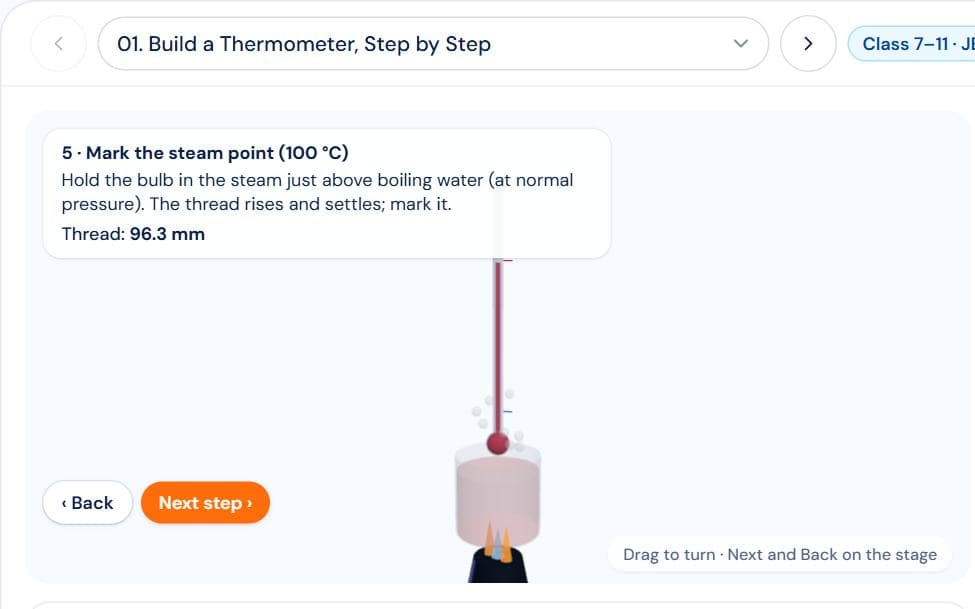
How is a thermometer actually made? This 3D liquid-in-glass thermometer simulation builds one step by step, all in one place: choose a glass bulb with a very fine bore, fill it with red alcohol by warming the bulb and letting the cooling air draw the liquid in, seal the top in a flame, stand it in melting ice to mark the lower fixed point, hold it in steam above boiling water to mark the upper fixed point, divide the gap into a hundred equal degrees — and then use it to read the temperature of a beaker of water. Press Next on the stage to go from one step to the next, and watch the thread slide to each new temperature.

The second module asks what makes one thermometer more sensitive than another: a bigger bulb, a narrower bore, or a liquid that expands more, since the thread rises by V_bulb(γ_liquid − γ_glass)/A_bore for every degree. The third converts between Celsius, Fahrenheit and Kelvin, and shows how to correct a faulty thermometer whose fixed points were marked wrongly — the linear-scale questions that appear in every exam from Class 7 to JEE.

Also covers: liquid in glass thermometer, how a thermometer works, making a thermometer, alcohol thermometer, mercury thermometer, fixed points, ice point, steam point, calibration of thermometer, sensitivity of thermometer, celsius fahrenheit kelvin, faulty thermometer, apparent expansion, class 7 heat, class 11 thermal properties.

Frequently asked questions

How does a liquid-in-glass thermometer work?

The liquid in the bulb expands when it warms, more than the glass does, and the extra volume is forced up a very narrow bore. Because the bore is so fine, a tiny change in volume makes a long change in the length of the thread, which is read against a scale.

What are the fixed points of a thermometer?

Two temperatures that can be reproduced exactly: the ice point, pure melting ice at 0 °C, and the steam point, steam above boiling water at standard pressure at 100 °C. Marking these and dividing the gap into 100 equal parts gives the Celsius scale.

Why is alcohol used instead of mercury in some thermometers?

Alcohol freezes at −114 °C, so it works in very cold places where mercury (−39 °C) would freeze; it expands about six times as much, so the scale is longer; and it is much less toxic. Its drawback is its low boiling point, 78 °C.

How do you correct a faulty thermometer?

Any linear scale satisfies (reading − lower mark)/(upper mark − lower mark) = C/100. A thermometer reading 4 in ice and 100 in steam that shows 52 is at (52 − 4)/96 × 100 = 50 °C.