About the LC Oscillations simulation
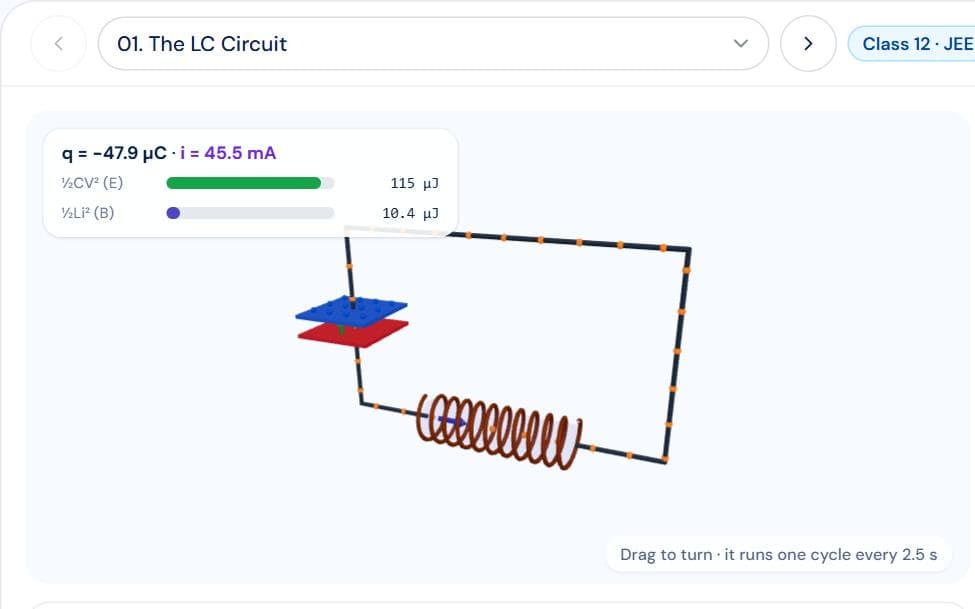
An LC circuit is a capacitor and a coil joined in a loop, and it is the electrical twin of a mass on a spring. This 3D LC oscillations simulation charges the capacitor and closes the loop: charge drains off the plates through the coil, the current builds and the coil's magnetic field swells, and when the capacitor is empty the coil keeps the current going and charges it the other way round. The stage runs by itself, one cycle every two and a half seconds, with the energy bars for ½CV² and ½Li² trading places as it goes.
The second module puts a block on a spring beside the circuit, moving in step: charge is displacement, current is velocity, inductance is mass and 1/C is stiffness. The third adds resistance, which heats up and drains the energy each cycle, so the oscillation dies inside an envelope e^(−Rt/2L) — and at the critical resistance 2√(L/C) the charge simply creeps back to zero without swinging. Each module has a prediction, a derivation, exam-style questions with hints and fresh numericals.
Also covers: lc circuit, lc oscillation, oscillating circuit, tank circuit, energy in capacitor and inductor, electric and magnetic energy, natural frequency 1/2π√lc, lcr circuit, damped oscillation, critical damping, critical resistance, quality factor, mass spring analogy, class 12 alternating current, jee lc oscillation.