About the Huygens' Principle: Reflection & Refraction simulation
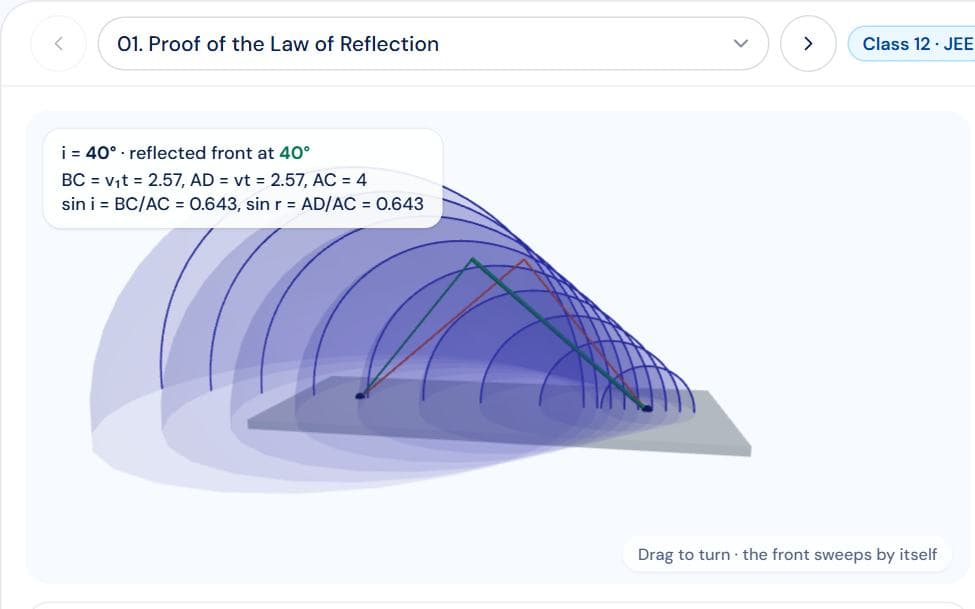
Huygens' principle says that every point on a wavefront acts as a source of secondary wavelets, and the new wavefront is the surface touching them all. This 3D Huygens' principle simulation sends a plane wavefront sweeping onto a mirror: each point of the mirror starts its own wavelet, drawn as a growing dome, the instant the front reaches it, so the first point hit has the biggest wavelet and the last has only just begun. The reflected wavefront is the plane tangent to all of them.
When the front has swept the whole surface, the two right-angled triangles of the NCERT proof light up: BC, the distance the far end of the front still had to travel, equals AD, the radius of the first wavelet, and they share the hypotenuse AC — so the triangles are congruent and the angle of reflection equals the angle of incidence. The second module repeats the construction for a boundary into a slower medium, where the wavelets below the surface are smaller, and the same two triangles prove Snell's law, sin i/sin r = v₁/v₂. Each module has a prediction, a derivation, questions and practice numericals.
Also covers: huygens principle, huygens construction, secondary wavelets, wavefront, proof of law of reflection, proof of snell's law, reflection of plane wave, refraction of plane wavefront, envelope of wavelets, class 12 wave optics, ncert wave optics derivation, jee wave optics.