Skip to content
Heat & Matter · Physics

Heat Conduction Simulation: Rods in Series & Parallel

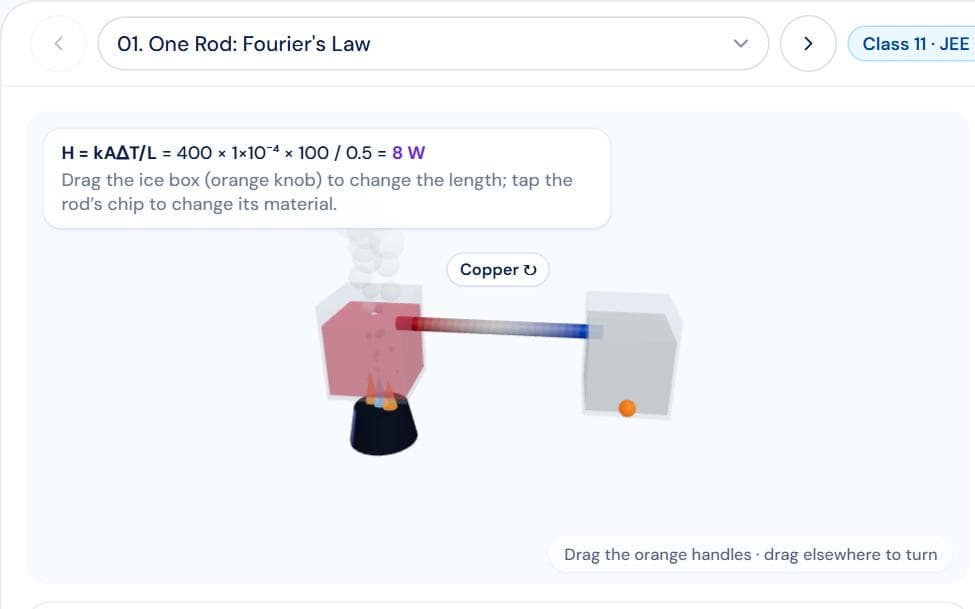
Rods between a boiling-water bath and melting ice, in 3D, glowing by temperature with heat current flowing along them as moving dots. Change the material, length and thickness of one rod; join two end to end and find the junction temperature; put two side by side and add their currents; and meet three rods at one junction — the thermal-resistance method JEE uses, with ice melting at the cold end.

Interactive virtual lab · no download · works on phones and laptops

Chapter
Thermal Properties of Matter
For
Class 11 · JEE · NEET
Time
~25 min

Heat Flow Through Rods: Series & Parallel is a Pro simulation

Pro opens all 152 virtual labs — 693 simulations with guides and quizzes.

How to use it

  1. 1Pick a module from the list (4); set your level at the top right for more controls.
  2. 2Drag the orange knobs to stretch a rod or set an end's temperature; tap a rod's chip to change its material.
  3. 3Use Predict before you look, then Derive, Questions, Practise and Compare.

What to notice

  • Heat current H = kAΔT/L: thermal resistance R = L/kA, so H = ΔT/R like Ohm's law.
  • In series one current flows through both rods; the poorer conductor takes the bigger temperature drop.
  • In parallel the currents add; the conductances kA/L add.
  • At a junction the currents in and out balance: Tj = Σ(Tᵢ/Rᵢ)/Σ(1/Rᵢ).

For teachers

A ready-made teaching kit comes with this lab

  • Lesson plan

    27 min, 4 steps

  • Ask the class

    4 questions with answers

  • Quick quiz

    5 questions, printable

  • Key formulas

    5 formulas

About the Heat Flow Through Rods: Series & Parallel simulation

Conduction through rods is the JEE and NEET heat-transfer topic that is really a circuit problem in disguise. This 3D simulation puts rods between a bath of boiling water and a box of melting ice; each rod glows by temperature from red to blue and its heat current flows along it as moving dots — fast in copper, barely moving in wood. Change the material, length and cross-section and watch Fourier's law, H = kAΔT/L, while the ice at the cold end melts at H/L_f.

Join two rods end to end and find the junction temperature: the same current passes through both, so the poorer conductor takes the larger share of the temperature drop and the profile has a kink at the joint. Put two side by side and their currents add. Write R = L/kA as a thermal resistance and these become the series and parallel rules of electric circuits, with equivalent conductivities for each.

The last module meets three rods from three baths at one junction — the node method: the junction settles where the heat flowing in equals the heat flowing out, T_j = Σ(T/R)/Σ(1/R). Every module has a prediction, a derivation, concept questions and fresh numericals.

Also covers: heat conduction, thermal conductivity, fourier's law, heat current, rate of heat flow, kaδt/l, thermal resistance, l/ka, rods in series, rods in parallel, equivalent thermal conductivity, junction temperature, temperature gradient, three rods junction, y junction rods, ice melting by rod, steady state conduction, electrical analogy of heat flow, class 11 thermal properties, jee heat transfer.

Frequently asked questions

What is thermal resistance?

R = L/kA, in kelvin per watt. With it, the heat current through a rod is H = ΔT/R — exactly like Ohm's law I = V/R, with temperature difference in place of voltage. Rods in series and parallel then combine like resistors.

How do you find the junction temperature of two rods in series?

In steady state the heat current through both rods is the same, so k₁A(T₁ − T_j)/L₁ = k₂A(T_j − T₂)/L₂. Solving, T_j = (T₁/R₁ + T₂/R₂)/(1/R₁ + 1/R₂). For copper and iron of equal size between 100 °C and 0 °C, T_j ≈ 83 °C.

What is the equivalent thermal conductivity of rods in series and in parallel?

In series (equal areas): k_eq = (L₁ + L₂)/(L₁/k₁ + L₂/k₂), which for equal lengths is 2k₁k₂/(k₁ + k₂). In parallel (equal lengths): k_eq = (k₁A₁ + k₂A₂)/(A₁ + A₂), which for equal areas is the plain average.

Why is the temperature along a rod a straight line in steady state?

In steady state no heat is stored anywhere, so the same heat current crosses every section of a lagged rod. By Fourier's law the gradient dT/dx = H/kA is then constant: the temperature falls linearly from the hot end to the cold end.