About the Fermat's Principle of Least Time simulation
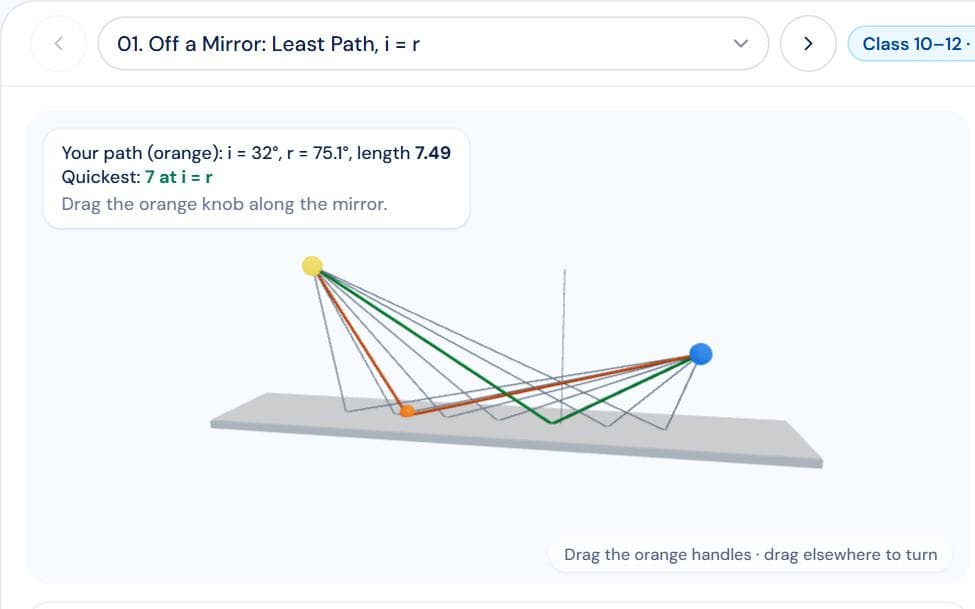
Fermat's principle says light travels between two points along the path that takes the least time. This Fermat's principle simulation makes that visible: beads leave a lamp along a whole fan of paths at the same instant, each moving at the speed of light in its medium, and race to the target. The green bead always wins, and you can drag the crossing point to put your own orange path onto the winner's.
Off a mirror the quickest path is simply the shortest, and it has equal angles — the law of reflection, found with the image method. Into glass, where light is slower, the straight line is no longer quickest: the winner bends towards the normal so it spends less distance in the slow medium, which is Snell's law n₁ sin i = n₂ sin r (the lifeguard problem). The third module explains why a lens focuses: rays through the edge travel further in air, the central ray goes through more glass, and only at the image do all their times match — the lens formula is Fermat's principle in disguise.
Also covers: fermat's principle, principle of least time, least time path, law of reflection proof, snell's law derivation, lifeguard problem, optical path length, image method reflection, lens equal optical path, why light refracts, class 12 ray optics, jee optics.